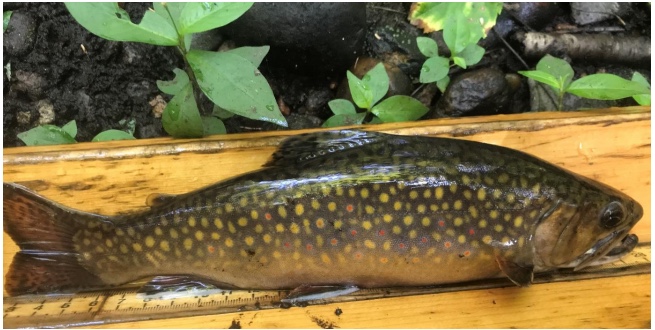
Join the CT Council of Trout Unlimited, TU staff as we talk with Mike Beauchene and Brian Eltz of the CT DEEP on a new report they just completed – A Random Revisit of the Statewide Stream Survey Project – which found a nearly 30% drop in Brook Trout in a one-year survey, versus results from a comprehensive study 30 years ago.
While the study is only a snap-shot in time from 2017-18, the results are concerning. Join this important call to learn what was found, what the DEEP and TU are doing to protect our state’s native trout, and how you can help.
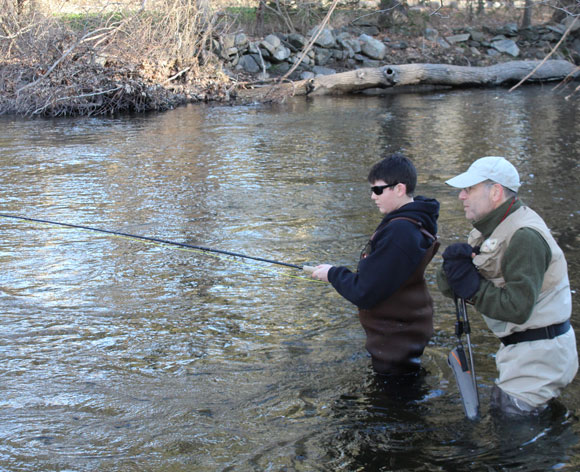
Sunday, June 21, is Free Fishing License Day in Connecticut.
Anyone can fish for free, after getting the free one-day license via the Connecticut Department of Energy and Environmental Protection online licensing system. All other rules and regulations apply but enjoy a day of fishing.
If you love fishing or believe in the value and need for protecting rivers, we want you to be a part of the Trout Unlimited community.
Today, our membership and representation aren’t reflective of the racial diversity in the fishing and river-loving communities. An equitable, diverse and inclusive community is important to us, but it is still under construction. Though our work was underway with significant personal and organizational learning and action, the recent events surrounding the murders of George Floyd, Breonna Taylor, Ahmaud Arbery and too many others before them, have re-emphasized how important it is to amplify voices of color in this journey.
The Senate voted Wednesday 73 to 25 to pass the Great American Outdoors Act, a bill that permanently and fully funds the Land and Water Conservation Fund and provides money for the growing maintenance backlog on public lands.
Up next is the House of Representatives version of the bill, H.R. 7092, which was introduced by Rep. Joe Cunningham (D-SC) on June 4 with strong bipartisan support. The legislation currently has nearly 50 cosponsors from around the country.
The Land and Water Conservation Fun (LWCF) is our country’s premier program to fund public access, fish and wildlife conservation and outdoor recreation. Public access and habitat conservation are critical to sustain hunting and fishing in America. LWCF supports these pillars of our sporting heritage and it is imperative that Congress provide full, dedicated funding for this vital program.
The public lands maintenance backlog has been mounting for decades and is now estimated at nearly $20 billion. This issue has created a host of problems that impair trout fisheries, including substandard roads that bleed sediment into streams and defective culverts that block fish migration. It is crucial that the National Park Service, Forest Service, BLM, and Fish and Wildlife Service all receive funding to tackle the growing maintenance backlog.
Trout Unlimited President and CEO Chris Wood issued a statement this week saying the organization will work toward creating an environment of greater equity.
In part, Wood wrote:
Good comes when we listen more, understand more, and judge less — when we seek compassion and ways to help our neighbors. Good comes from building an America that truly protects the rights and freedoms of all its people.
Inequity and violence destroy. When we build community, we create.
Trout Unlimited and its 300,000 members and supporters will play an active role in efforts to build a more inclusive community across the nation. We cannot simply ignore the news, go fishing, and wait this out. Trout Unlimited will be part of the solution by addressing the inequities in our communities, and by building space for all people to participate in our mission of conserving, protecting, and restoring our watersheds.
President Donald Trump Friday opened the door to commercial fishing in the only federal ocean Monument in the Atlantic. This precious marine preserve, Northeast Canyons and Seamounts, 150 miles off our coast is a haven of pristine waters and diverse wildlife.
The creation of the Monument in 2016 by President Barack Obama was brought about with strong advocacy from the entire Connecticut delegation, led by Sen. Richard Blumenthal. Rivers Alliance and many other environmental groups are asking you to join us in contacting Rep. Jim Himes, Rep. Rosa DeLauro and Sen Chris Murphy, who are key
Inflicting harm on this preserve will not save our fisheries. Quite the opposite. The fisheries of the future depend on deep-sea breeding and nurturing preserves. NE Canyons and Seamount is the only one we have in our region.
Rep. Himes Bridgeport Office: 203-333-6600 or 866-453-0028
The May 2020 study reports: “Statewide, we found a decrease in the number of locations (about 33% ) as well as an overall decrease in the number of fish.”
“Connecticut’s landscape and climate has changed over the past three decades. These changes are predicted to continue and most likely have a negative impact on cold water obligate fish species such as Brook Trout,” according to the report by Brian Eltz and Mike Beauchene of the DEEP.
Pointing out that the Brook Trout is Connecticut’s only native, non-migratory salmonid, they write, “As a species with specific cold water requirements, the future of wild Brook Trout in Connecticut in the context of climate change and increased development is uncertain and potentially in jeopardy.”
The authors recommend drawing a new list of randomly selected sites every 5 years to compile a series of statewide estimates of wild Brook Trout distribution and population density values.
Starting now, additional work using the universe of locations where wild Brook Trout were not observed is warranted. This work should seek to identify key variables responsible or related to the absence of wild Brook Trout and determine their magnitude of change. Some categories of variables, which may have changed from the initial sampling over 30 years ago include land cover, out of stream diversion of water and stocking of adult domestic trout (brooks, browns, rainbows, and tigers) in the same reach containing wild populations, stocking of Atlantic Salmon and Brown Trout fry, harvest limits, size limits, etc..