Holiday party Jan. 21

Nutmeg TU has postponed its holiday to its January meeting, scheduled for Tuesday, Jan. 21 at 7 p.m., at Port 5, 69 Brewster St., Bridgeport, CT.

The party was originally scheduled for Tuesday, Dec. 17, but was postponed due to weather and travel conditions.

The program remains the same for January.

Those with last names starting in letters A-H are asked to provide the main course; those with names starting in letters I-Q are asked to provide appetizers. Those with names starting with letters R-Z are asked to bring dessert. You do not need to bring food, but folks who do will get an extra ticket.

Click here for more word on prizes available at the event.

There will be demonstrations of fly tying and knots that all anglers can use.

Those who plan to attend are asked to RSVP by commenting on this post.

If a tree falls in the river…

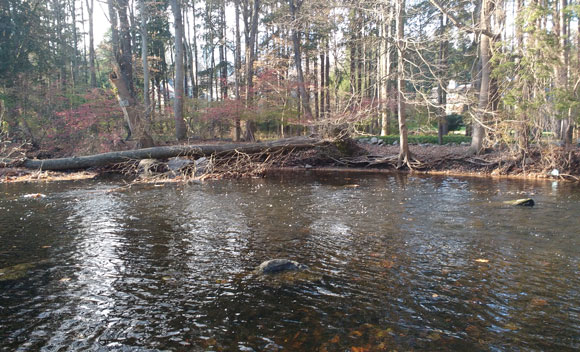
A tree has fallen and is partially covering a favorite pool in the William “Doc” Skerlick Fly Fishing Only section of the Saugatuck River Trout Management Area in Westport.

What to do?!?

Actually, this is a blessing in disguise!

Why are large woody debris important?

Wood helps stabilize shorelines and provides vital habitat for trout and other creatures. Preserving and even increasing the amounts of large woody debris along shorelines is important for keeping our aquatic areas healthy and improving the survival of native trout and other animals.

Some key benefits of large woody debris to fish and other aquatic creatures:

  • It provides refuge for juvenile and adult fish at a wide range of river flows, such as flood events.
  • It creates pools for juvenile fish and hydraulic complexity and roughness along the river bank
  • It provides food sources and habitat for aquatic insects and wildlife along shorelines.
  • It helps stabilize shorelines and reduce excessive erosion.

(Source: https://www.kingcounty.gov/services/environment/water-and-land/shorelines/about/shoreline-ecology/large-woody-debris.aspx)

Trout just feel safer where there is large woody debris, and their numbers are higher there and in surrounding areas. That is why Nutmeg TU is installing revetments and adding large woody debris to the Mill River – currently focusing on the Congress Street section! As TU members like to say, ” If you take care of the fish, the fishing will take care of itself”.

If you’re interested in reading more, check out:

Redds survey moved to Friday, Nov. 29

A chance to learn about the salmonid life cycle and how to help find trout nesting sites, or reeds, has been moved to Friday, Nov. 29, at 9 a.m.

Click here for a video.

We’ll meet at the Mill River WTMA (Wild Trout Management Area) in Easton, at the bottom of the big hill on South Park Avenue by the bridge.

Please bring polarized sunglasses to see through the glare of the water, a snack and drinks, waders (though we’ll try to stay out of the water as much as possible) and a cell phone. Please plan to spend up to a couple of hours doing this.

Accomplished lifelong conservationist Mike Piquette will be leading this, and it’s a tremendous learning opportunity open to all TU members. We hope that once you have participated you will consider joining us on doing yearly redd counts in late fall/early winter.

The event was scheduled for Sunday, Nov. 24, but postponed due to water conditions.

  • What is a redd?
    Redds are spawning sites of salmonids (in Connecticut that mostly means wild brown trout and wild & native brook charr.) Favored locations in rivers and streams where they bury their eggs in depressions in the gravel created by kicking the gravel up with their tails. They are fairly easy to spot when river conditions allow it.
  • Why do this?
    Redd counting a very useful fishery management tool for anglers, conservationists and regulatory bodies. It provides the following information*:
    • A record of the spawning range in each year under specific flow conditions
    • A comparison between years, allowing trends to be identified over time
    • Identifies obstructions to fish passage
    • Identifies areas of clustered spawning
    • Identifies under-utilized spawning habitat
    • The identification and later assessment of gravel cleaning sites
    • Provides spawning data for the interpretation of fish population surveys
    • Enhance awareness of wild brown trout and native brook charr spawning within the Mill River

Click here is an example of a TU Redd Count report.

*Source: http://www.casterbridgefisheries.co.uk/environmental-monitoring/redd-counting/

The Clean Water Rule is under attack

The Clean Water Rule is under attack, leaving headwater streams and wetlands vulnerable. If you have a few minutes, check out this blog entry by Chris Wood, TU’s President and CEO: We fish here so you can fish there (https://www.tu.org/blog/we-fish-here-so-you-can-fish-there/). Or if in a rush, just go to https://standup.tu.org/ to contact your member of Congress and tell them to defend clean water protections.

Steve Culton talks wet flies Nov. 19

Steve Culton of currentseams.com will discuss wet flies with Nutmeg TU on Tuesday, Nov. 19, at 7 p.m. at Port 5, 69 Brewster St., in the Black Rock section of Bridgeport.

Pizza is served, and beverages can be purchased through Port 5.

Wet flies have been taking trout for centuries — and the fish aren’t getting any smarter. More and more anglers are discovering that a wet fly is often the best way to match a hatch. Explore the wonders of the wet fly as we cover basics like wet fly types, leader construction, where to fish wet flies, and how to fish them.

Steve Culton is a Connecticut fly fishing guide and instructor, fly tyer, and freelance writer. His work has appeared in Field & Stream, American Angler, The Flyfish Journal, The Drake, Flyfishing & Tying JournalEastern Fly FishingFly Rod & Reel Online, and the Mid Atlantic Fly Fishing Guide.

Currentseams.com is a library for my articles, stories, fly tying, fishing reports, videos, my guide service The Fisherman LLC, and more.

Campville trip for salmon Nov. 16

Come fish the Campville section of the Naugatuck River with Nutmeg Trout Unlimited.  The Naugatuck River, Campville section is one of the places CT DEEP stocks bloodstock Atlantic Salmon in the fall.  The upper Naugatuck River winds its way through heavily wooded portions of the Mattatuck State Forest and other public lands. In the Campville section, the river is smallish with some deeper runs and pools as well as plunge pools and waterfalls below which the Atlantic Salmon tend to hold up.  This area is also stocked with Trout, so Salmon are not the only game in town.

When:  Saturday, November 16 at 10 AM.  

Where:  Campville Section of the Naugatuck River off Exit 41 of Route 8.

Directions:  From Route 8 North, take Exit 41.  Turn right onto Campville Road which becomes Northfield Road then goes over the river.  At the T intersection, turn left onto Valley Road and park at the numerous spots along the road before Campville Hill Road.  River will be on your left.  

Regulations:  Must have current CT Fishing License with a Trout/Salmon Stamp.  

Must use a single fly or lure with a single free-swinging hook only; no treble hooks.  Additional weight may not be added to the line.  Fishing is catch and release at this time; DEEP has extended the catch and release date for Salmon to December 15 this year.  

General Information:  Salmon, particularly larger fish, are very powerful so you may want to consider scaling up your tackle.  For fly anglers:  a heavier rod, like a 7 or 8 wt. and a reel with a strong drag.  For spin/casting anglers:  a medium action rod in the 8 – 10 lb. class.  Or you can do what I do and fish a standard 5-weight trout set-up and hope for the best if you hook a Salmon!!  As there are plenty of deep spots in this section, a sink tip line can come in handy to get your fly down, particularly if the river is running high.  

Water (and possibly weather) may be cold so please dress accordingly.  

Hope to see you there!!  

Nutmeg TU Contact:  Alex Ziemkiewicz  agz3026@gmail.com or 203-209-6689.

Nutmeg TU seeks river stewards

Many of you have a favorite river and all of us are conservation minded, or we wouldn’t belong to TU. The Board of the Nutmeg chapter of TU is looking to pilot a program we are calling “River Stewards” and we are seeking volunteers to lead and help. How far we take the program will depend on member interest and participation.

The range of activities can be as simple as walking the river and reporting issues in the TU RIVERS app (to be discussed soon). From there the River Stewards could do stream cleanups, macro-invertebrate and temperature logging to measure the health of the river, or even go as far as remediation of problems identified. It’s all up to the volunteers to as to how much we do.
There are no obligations except to get involved and help us preserve and protect our local rivers and fisheries as you are able to.
These River Stewards will work with the chapter’s Conservation Chair and be provided with support and training such as (but not limited to) invasive species identification and removal, water temperature monitoring and more. 
If you want to find out more please contact Gian Morresi at gmorresi@gmail.com and he will contact you to discuss next steps.

Thanks Nutmegers
Best,
Gian203-243-4587

The DEEP found healthy populations of trout and smallmouth during electrofishing surveys of the Housatonic and Farmington Rivers (DEEP Photo)

DEEP wants to hear from anglers

The Fisheries Division of the Department of Energy and Environmental Protection is in the midst of mapping a path forward for trout and salmon fisheries here in Connecticut, with the goal of optimizing the quality of our salmonid fisheries and maximizing the utilization of fish produced at State Fish Hatcheries.

To that end, officials would like to meet with anglers and hear what you have to say. They will be hosting a series of discussions throughout the month of October.

These meetings are free to attend, however, to make sure we have adequate space for everyone we are asking for an RSVP.  You can use one of the links provided on the first page of Sept. 27 weekly fishing report (once the link opens, select the register button), call 860-424-4185, or email mike.beauchene@ct.gov

Each meeting will begin with a brief presentation about the Fisheries Division’s management of trout and salmon to date and then expand to discussion on four key focal points related to trout and salmon fishing

• What makes a good fishing trip?

• Where can the Fisheries Division improve?

• What actions could be taken to increase the number people fishing?

Volunteers turn out for Mill River project

Some 20 volunteers from around the area turned out Saturday, Sept. 14, to help Nutmeg TU continue its river revetment project on the Mill River along Congress Street in Fairfield.

Supported by a TU Embrace a Stream grant, the installation of discarded Christmas trees along the banks will reshape the river and create more habitat for trout.

Ed Grzeda captured these images of a productive morning on the river.