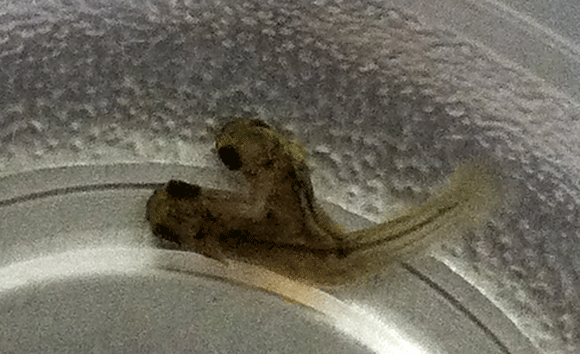
Conjoined trout hatched for the Trout in the Classroom program Meadowside School in Milford.

Rare find in TIC hatch

Conjoined trout hatched for the Trout in the Classroom program Meadowside School in Milford.

The Trout in the Classroom program at Meadowside School in Milford, sponsored by Nutmeg TU, got a surprise when their eggs recently hatched.

Fifth grade teacher Jason Cicero sent this photo of conjoined fry to Gian-Andrea Morresi, TIC coordinator for the Nutmeg Chapter of Trout Unlimited.

“The fish are doing great but when I checked them yesterday I noticed something amazing and wanted to share it with you. We have conjoined twins in our nursery,” Cicero wrote. “I hope the picture comes across so you can see this, it’s amazing! “

“That is different,” DEEP biologist Neal Hagstrom wrote. “Usually you have them belly to belly and often one embryo will overgrow the second before they are this developed.  Sometimes all that is left is an extra fin. Looks like completely separate digestive, neural and circulatory system. Neat shot.”

Trout in the Classroom is TU’s cornerstone environmental education program. Students learn about the importance of clean, cold water as they raise trout from eggs, ultimately releasing them into the wild.
Magazine renewal scam targets TU members

Trout Unlimited is alerting members across the country to a scam.

A company called Platinum Publishing sent renewal invoices for TROUT magazine for $79.95 to some of TU members.

“Please be advised that this is a scam and did not originate from TU’s offices,” according to an alert in the most recent Lines and Leaders.

Members are advised to not respond to these invoices, “but rest assured tu.org and our Woolly Bugger, WV, post office box are fully operational, secure and ready to process dues and gifts.”

Construction of bypass under way at Tingue Dam

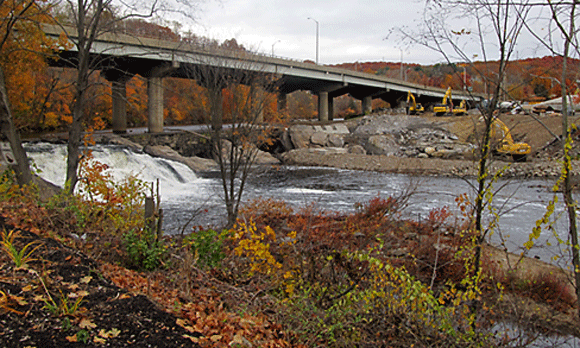
Ron Merly captured this image of work on construction of a fish bypass at the Tingue Dam in Seymour.


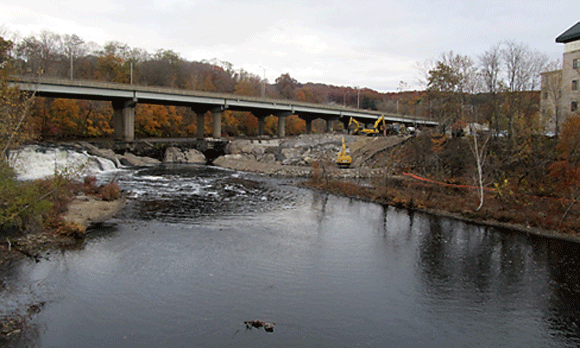
Work on the fish bypass at the Tingue Dam in Seymour continues along the Naugatuck River.

The Tingue Dam bypass is one of seven environmental projects that officials have chosen to fund with $2 million from the 1999 Housatonic River settlement.

The bypass will increase habitat for migratory fish, such as river herring via construction of a bypass channel to facilitate fish movement around the dam on the Naugatuck River as far north as Thomaston. When complete, the project will immediately restore access to 32 miles of habitat essential to spawning of numerous species including shad, alewife and American eel.


Nymphing demystified on Nov. 19

Bill Keister will take the mystery out of using nymphs to catch trout at the Nov. 19 meeting of Nutmeg Trout Unlimited 217.

The meeting will be held from 7-9 p.m. at Port 5 Naval Veterans, 69 Brewster St., Bridgeport.

“Is nymphing a mystery?  Could your nymphing be more effective?” Keister writes. “The presentation is conducted as workshop where interaction is encouraged.  The program starts with definitions and explanations of long line and high stick nymphing. Particularly effective flies are described. Rods, lines, leaders, strike indicators and methods to get flies down are covered. The importance of drag free drifts is explained.  The causes of drag are described.  Casts and method for eliminating drag are covered. Questions will be answered at any time during the presentation.”

Bill Keister is a Federation of Fly Fishers (FFF) certified Master Casting Instructor (MCI). He ties his own flies and makes most of his fly rods. He has caught trout and salmon in Labrador, Newfoundland, Kamchatka, the Kola Peninsula, Alaska, Chile and three additional Canadian provinces and fifteen US states. Each spring he catches 200 to 300 fish nymphing on Connecticut’s Salmon River.

DEEP reports more salmon stocked

DEEP began spawning salmon at the Kensington Hatchery last week and approximately 100 spawned salmon were stocked out earlier this week in the Naugatuck River (upper – 25 fish, lower – 25 fish) and Shetucket River (50 fish).

These fish range in size from 2 to 15 pounds, and average 10 pounds each.

These stockings will bring the number of broodstock Atlantic salmon stocked this fall to approximately 1,800.

CLICK HERE TO READ THE DEEP WEEKLY FISHING REPORT.

TU attracting female anglers

Trout Unlimited is offering a free introductory membership for female anglers.

For the next year, women who join will receive all the benefits of a paid membership:

•            1-year subscription to TROUT magazine

•            16-month TU calendar (mailed in the fall)

•            official TU membership card

•            car rental & hotel discounts

•            TU decal

•            Local chapter membership

And another, less tangible benefit: the pleasure of knowing you’re part of a growing community of women who enjoy angling and want to keep America’s rivers cold, clean and fishable.

This offer is available to new members only. Not applicable for existing members.

Click here to join.


Salmon stocked in the Naugatuck

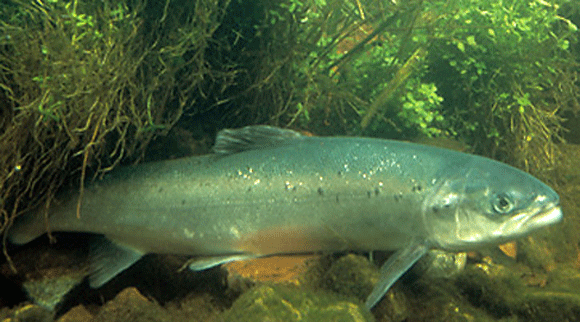
The Connecticut DEEP has stocked Atlantic salmon in the Naugatuck River. (Photo by William Hartley/U.S. Fish & Wildlife Service)

Connecticut’s Department of Energy & Environmental Protection has begun the 2013 autumn stockings of broodstock Atlantic salmon.  DEEP’s Inland Fisheries Division recently released 300 salmon into the Naugatuck River and Mount Tom Pond.  Later this week, DEEP will release 300 salmon into the Shetucket River and Crystal Lake.

“Atlantic salmon are renowned for their size, beauty and fighting ability,” said Peter Aarrestad, Director of DEEP’s Inland Fisheries Division.  “The Atlantic salmon recreational fishery has become quite popular, and catching one of these large leapers provides a thrilling experience for anglers.”

The Atlantic salmon being stocked in Connecticut were raised in the Kensington State Fish Hatchery and are the progeny of sea-run fish that returned to the Connecticut River.  Salmon at this hatchery were raised to provide eggs for the Connecticut River Atlantic Salmon Restoration Program that began in 1967.  Since 1992, surplus and spawned fish from this program were made available to provide a recreational fishery for Connecticut anglers.

Click here to read more in The Valley Gazette.


Streamflow changes proposed in some rivers

DEEP has taken the first step toward implementation of streamflow protections. This step is the classification of streams within a given watershed as Class 1 to Class 4 (high quality to terrible quality). The classification determines the level of flow protection that will be accorded under the regulation.

The Connecticut Council of TU said DEEP has done an outstanding job in creating maps that present most of the information essential to understanding the classifications and reasons for the classifications. It has started with the eastern portion of the state.

“It is very important for friends of rivers all across Connecticut to review and comment on these maps,” according to a notice from the council. “You may want to advocate for certain adjustments to the rationale or process of classification.”

The DEEP has prepared maps of proposed stream flow classifications for the Southeast Coastal, Pawcatuck and Thames Major River Basins, available online. The maps include river and stream segments in Andover, Ashford, Bolton, Bozrah, Brooklyn, Canterbury, Chaplin, Colchester, Columbia, Coventry, East Lyme, Eastford, Franklin, Griswold, Groton, Hampton, Hebron, Killingly, Lebanon, Ledyard, Lisbon, Mansfield, Montville, New London, North Stonington, Norwich, Old Lyme, Plainfield, Pomfret, Preston, Putnam, Salem, Scotland, Sprague, Stafford, Sterling, Stonington, Thompson, Tolland, Union, Vernon, Voluntown, Waterford, Willington, Windham, and Woodstock.

Public information sessions will be held at:

Northeast CT Council of Governments, 125 Putnam Pike, Dayville, on Tuesday, Oct. 15, in two sessions: 2-4 p.m. and 6-8 p.m.

Southeastern CT Council of Governments, 5 Connecticut Ave., Norwich, on Wednesday, Oct. 16, in two sessions: 2-4 p.m. and 6-8 p.m.

A short presentation on how the stream flow classification maps were developed will be given, copies of the maps will be available for inspection, and Department staff will be on hand to answer questions at these information sessions.

The proposed stream flow classification of a stream or river segment is based on ecological conditions and human use characteristics, and determines flow management goals and applicable flow standards for that segment. Proposed stream flow classifications were developed using known information on factors indicative of the degree of human alteration of natural stream flow, environmental flow needs and existing and future needs for public water supply.

The public may submit additional information or comments for the Commissioner’s consideration on the proposed classification of a specific river or stream system pertaining to, but not limited to: (i) the factors for consideration in the regulations; (ii) the impact of the proposed classification on any prior investment made to develop a permitted or registered diversion and the alternatives, if any, to the diversion including cost factors and feasibility of such alternatives; (iii) the relationship of an existing or proposed diversion to economic development or jobs; and (iv) the practicality of, and potential for, achieving ecological benefit from restoring streamflow to the specific river or stream system. Written comments may be submitted by email to deep.streamflowclass@ct.gov, or may be mailed to Robert Hust, Department of Energy & Environmental Protection, Bureau of Water Protection and Land Reuse, 79 Elm Street, Hartford, Connecticut, 06106-5127. The Department is accepting additional information or written comments on the proposed Streamflow Classifications until Tuesday, Dec. 31, 2013.

Additional information on the Stream Flow Standards and Classifications is available on the Department’s website at: www.ct.gov/deep/streamflow . Anyone requiring more information may contact the Department by email at deep.streamflowclass@ct.gov or by phone at 860-424-3020.

The Connecticut Department of Energy and Environmental Protection is an Affirmative Action and Equal Opportunity Employer that is committed to complying with the Americans with Disabilities Act. To request an accommodation call 860-424-3194 or email deep.accommodations@ct.gov.

The Rivers Alliance will also help with questions. Information can be found at www.riversalliance.org.