Free fishing day May 13

Saturday, May 13, is Free Fishing Day in Connecticut.

Anyone can fish, inland or marine waters, without having to have a fishing license. According to the state Department of Energy and Environmental Protection, this is a great chance to share your passion for fishing with your whole family, your significant other, or your BFFs.

All size limits, harvest limits, and other regulations still apply.

Good luck!

Biologist shares info on big fish

Mike Humphreys, the DEEP Inland Fisheries Biologist for the western district, will speak at the next meeting of Nutmeg TU, set for Tuesday, March 21, at 7 p.m. at Port 5, 69 Brewster St., Bridgeport.

Mike is a longtime fish biologist, holding a master’s degree from the University of Tennessee with more than 30 years in his profession.

His topics will include updates on the Housatonic River, focusing on trout in the Cornwall TMA, and an assessment on wild trout in Connecticut streams, as well as the latest information about the effects of the recent drought on fish in the state.

In past 25 years with the Connecticut Department of Energy and Environmental Protection, his work has focused on Statewide Stream Electrofishing Surveys, a Statewide Wild Trout Research and Management Project, and Housatonic River Research and Management.

During previous, well attended visits, Humphreys spoke to Nutmeg TU about his findings on trout survival with run of river in the Housatonic TMAs, various fish stocking programs, and regulation changes for some sections of the Mill River.

Next meeting to be held March 24

saint-patricks-day-clipartDue to the third Tuesday of this month falling on St. Patrick’s Day, March’s membership meeting will move to the fourth Tuesday of the month, March 24, 2015. This change only affects this March’s meeting.

Mike Humphreys DEEP Inland Fisheries Biologist for the western district, our district, will speak. Of most interest to our chapter, he will  present findings from his 5 year study of the effects on trout survival in the Housatonic TMAs from run of the river and different stocking programs, and changes in wild trout management areas, which will include planned changes to the regulations governing sections of the Mill River. Mike will also discuss the Farmington River.

This should be a most informative meeting. Please update your calendars with the change to March 24, 2015 for this meeting. The meeting starts at 7 p.m. at Port 5 in Bridgeport

Trout stocking under way

Connecticut’s Department of Energy and Environmental Protection (DEEP) announced March 31 that expects to stock almost 390,000 trout in waters across the state in time for opening day of the trout fishing season April 19 despite challenges posed by extended winter conditions this year.

“Stocking nearly four hundred thousand fish prior to opening day is a monumental task in the best weather,” said Pete Aarrestad, director of DEEP’s Inland Fisheries Division. “We’ve had to postpone several days of stocking due to morning temperatures in the single digits, and a number of other scheduled stocking runs were shifted to sites with better winter access.

“However, we still plan to stock all of the usual water bodies that have historically been done for opening day.  Hatchery staff have endured and prevailed under prolonged winter conditions unseen in Connecticut in over 50 years. It is a testament to their ‘can do’ attitude and dedication on behalf of recreational anglers.”

More than 200 truckloads of trout are scheduled to be released into 100 lakes and ponds and 194 rivers and streams in time for opening day. The following species & sizes will be stocked prior to opening day:

• 62,600 brook trout (10-11 inch)

• 193,500 brown trout (10-11 inch)

• 6,600 brown trout (12 inch)

• 1,900 tiger trout (10-12 inch brook/brown hybrid)

• 107,300 rainbow trout (10-12 inch)

• 15,900 rainbow trout (12-14 inch)

• 1,335 surplus broodstock (3-10 pound trout – all species)

Trout anglers looking to test out their gear prior to the start of trout season can visit one of the state’s 15 trout management areas (TMAs), all open for pre-season catch-and-release fishing. TMAs are located on the Farmington River, Hammonasset River, Hockanum River, Housatonic River (two TMAs), Mianus River, Mill River (Fairfield), Mill River (Hamden), Moosup River, Pequabuck River (including Coppermine Brook), Naugatuck River, Salmon River, Saugatuck River, Willimantic River and Yantic River.

Typically, DEEP stocks nearly all these areas as soon as they are accessible by the hatchery trucks. This year, however, due to snow cover, frozen snow banks and shoreline ice cover, a number of the TMAs were inaccessible, thus stocking them had to be postponed. “Barring more winter weather, we plan on having most of the Trout Management Areas stocked by the end of next week,” said Aarrestad.

Anglers can access up-to-date information about where and when trout are stocked on Facebook at facebook.com/ctfishandwildlife.

In addition to the TMAs, class I wild trout management areas (WTMA) are also open year-round for catch-and-release fishing, and are located on Deep Brook, Eightmile River, Hawleys Brook, Beaver Brook/Merrick Brook, Macedonia Brook, Mill River (in Easton), Quinnipiac River, Tankerhoosen River, and Wachocastinook (Riga) Brook. Class I WMTA’s are typically not stocked. Additionally, downstream portions of six of the designated sea-run trout streams (Eightmile River, Farm River, Hammonasset River, Latimer Brook, Saugatuck River, and Whitford Brook) are open year-round with a two trout per day creel limit and a fifteen-inch minimum length.

Anglers should consult the Conncticut Angler’s Guide for detailed information on specific locations and angling regulations.  Printed versions of the 2014 Angler’s Guide are now available at more than 350 locations statewide, including town halls, bait & tackle shops and other vendors selling outdoor equipment, DEEP facilities, and commercial marinas and campgrounds. The electronic versions of the Guide can be found on the DEEP website at (ct.gov/deep/anglersguide).

Additional fishing and fisheries related information can be found on the DEEP web site at ct.gov/deep/fishing. The web site has a wealth of information including; trout stocking location maps, annual fish stocking summary report, the very popular youth fishing passport program, and when you catch the big one, criteria for trophy fish awards.

Save the last-minute running around and purchase your 2014 fishing licenses directly online, or if you prefer, at one of the many participating town halls, tackle retailers and DEEP offices. For a complete list of vendors, visit the DEEP website (ct.gov/deep/fishing) or call DEEP Licensing and Revenue (860-424-3105).

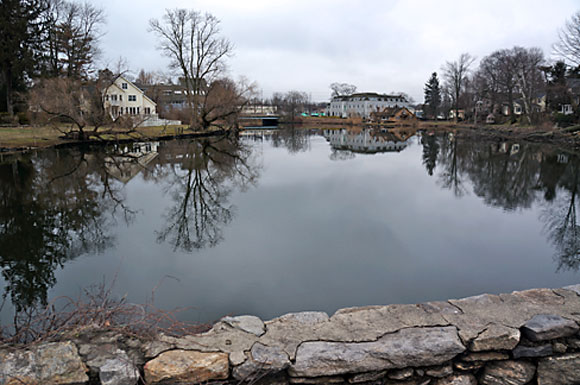
Beneath the surface of the lower Mill River lies lead and other waste from the former Exide battery plant. The company has announced a plan to clean the river, but some neighbors and conservationists fear what the work could stir up. (Fairfield Sun/Shawn O'Sullivan)

Meetings on Exide plan come to Fairfield

Local discussions of a plan to remediate industrial wastes left behind by the former Exide battery plant next to the Mill River are scheduled to begin this week.

The draft plan calls for the lower Mill River to be dredged. The full plan can be downloaded from the Fairfield Conservation Department website, at http://www.fairfieldct.org/conscomiss.htm.

The Harbor Commission will review a draft Remediation Action Plan (SedRAP) Monday, July 8, at 4:30 p.m. in the second floor conference room at Sullivan Independence Hall. Public comment will be allowed.

The Shellfish Commission will perform its review Wednesday, July 10, at 7:30 p.m., also in the second floor conference room at Sullivan Independence Hall.

The Board of Selectmen will also discuss the plan at a date to be announced, and permits will be required for all work.

A hearing with the Department of Energy and Environmental Protection is also pending.

If the Town of Fairfield, the DEEP, Exide and Fair PLAN, a local environmental group, can come to agreement on the plan, the DEEP hearing will be closed and work will begin.

But if those parties cannot agree on how to proceed, the hearing will continue and a hearing officer will determine the course of action based on evidence presented.

Hearings were held in March. Details on the entire process can be found at http://www.ct.gov/deep/cwp/view.asp?a=2719&q=517076&deepNav_GID=1654.

Nutmeg TU members commented during earlier hearings on the proposal.

Fish and fishing would be affected during implementation of the plan.

Part of the deliberations center on increased sediment suspension and a greater disruption to flora and fauna if more material is removed.

“A significant socio-economic issue to consider in assessing overall benefits is the anticipated impact to recreational fishing and shellfish harvesting during and after remedial activities,” the draft reads. “The analysis concludes that risk to humans through consumption of fish/shellfish or ingestion of lead-contaminated sediment is substantially elevated in Area II, and elevated in  Area I, with no substantial risks in Areas III, IV & V.  The present risks  must be weighed against the disturbance of these activities both during  and after remediation.  During remedial activities fishing/shellfish harvesting will not be physically possible in the immediate area of work and the destruction of substrates (i.e. submerged aquatic vegetation (SAV) and the benthic community) on which fish and shellfish are dependent may temporarily decrease fish and shellfish populations.  According to Exponent, recovery of SAV and the benthic community from dredging activities is expected to take 1-3 years.  These factors must be weighed against the overall remedial goal, which is complete removal of human risk from consuming lead-contaminated fish or shellfish.”

The long-term gains from removing lead, according to background in the plan, outweighs short-term disruptions.

Because a installation of a curtain that won’t restrict migration, dredging will not be allowed during the anadromous fish migration period in the Southport Harbor area, bounded by Harbor Road and a project limit line 225 feet south of Harbor Road.

Dredged material will be dried at the former Exide facility, 2190 Post Road, currently a vacant lot next to the Mill River, surrounded by a chain-link fence. That site will also be used for access and egress, staging of equipment and operations headquarters. The east bank of the Mill River, where work stopped during the 2005-09 Upland RAP, will need to be remediated and stabilized to allow the use of this area.

In preparation for the full project, the contractor would need to strip topsoil and install a layer of crushed stone. “The contractor may propose to install asphalt paving in lieu of crushed stone but will need to account for, through the use of engineered controls, any stormwater run-off that may results from this paving,” according to the draft plan.

Dredged material would be placed in Geotubes, “large bags made from a high tensile strength woven polypropylene fabric “geotextile” panels sewn to form long tubes for containment of pumped slurry,” according to the draft plan. The sediment will dry in those.

“In addition,” the plan continues, “two soil/sediment stockpile cells will be constructed using concrete barriers (construction block). Each concrete cell will have a capacity of no more than 250 cubic yards, surrounded by high-density sheeting to contain sediment.

The contractor will be required to “dredge, properly handle, transport and dispos of contaminated material (hazardous and non-hazardous), including characterizing the material, manifesting the loads, and obtaining approval from EPA-approved RCRA landfills and RCRA Out-of-State lined landfills,” according to the plan.

Fairfield’s sewer system cannot handle the volume of water discharged as the slurry is “dewatered,” according to the SedRAP, so filtrate will need to be discharged back into the Mill River.

Exide has applied to the DEEP to permit the discharge under a federal EPA program.

Bacteria sampling, if deemed necessary by DEEP and the Connecticut Department of Agriculture, will be conducted and evaluated by the agencies.

Exide has proposed construction of a “turbidity curtain,” or barrier, to contain sediment, with a corridor 15 feet wide and 2 feet deep to allow migration of fish from April through July.