Prosek to speak to support Aspetuck Land Trust

James Prosek signs copies of his book "Ocean Fishes" at Nutmeg TU's holiday party last December. A documentary on eels by the local resident will premiere on the PBS series "Nature" Wednesday, April 17.
James Prosek signs copies of his book “Ocean Fishes” at Nutmeg TU’s holiday party last December. A documentary on eels by the local resident will premiere on the PBS series “Nature” Wednesday, April 17.

Artist, angler and conservationist James Prosek will speak at the Aspetuck Land Trust’s Caryl and Edna Haskins Lecture on Tuesday, April 6, at 7 p.m. at the Westport Public Library.

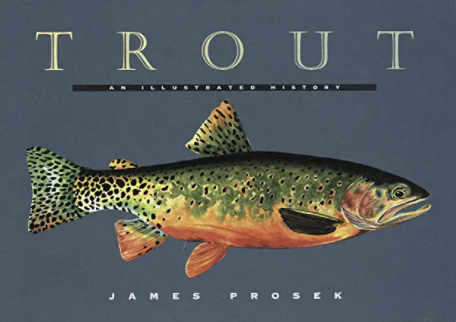
In 2022 the Aspetuck Land Turst is focused on the acquisition of 19 acres of Easton’s South Park property adjacent to the Warner Anglers Preserve. The importance of this property next to the Mill River, a Class 1 trout stream, one of only nine in the state, is not lost on this year’s Haskins Lecture special guest speaker James Prosek, who was only 19 and a student at Yale when he published Trout: An Illustrated History.

Trout: an Illustrated History, (Alfred A. Knopf) featured seventy of his watercolor paintings of the trout of North America,  and is widely recognized as having brought attention to the existence and plight of native trout. 11 books followed for adults and children alike including Art, Artifact, Artifice, (Yale University Art Gallery) Ocean Fishes, (Rizzoli) Bird, Butterfly, Eel, (Simon and Schuster Books) , Eels: An Exploration, from New Zealand to the Sargasso (Harper) and as well as articles for The New York Times and National Geographic Magazine.

Click here to buy tickets to the April 6 lecture.

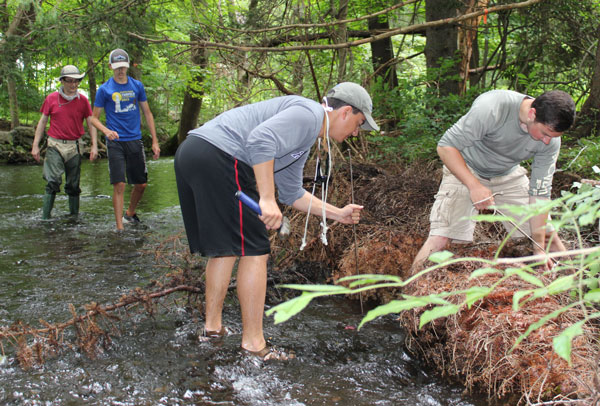
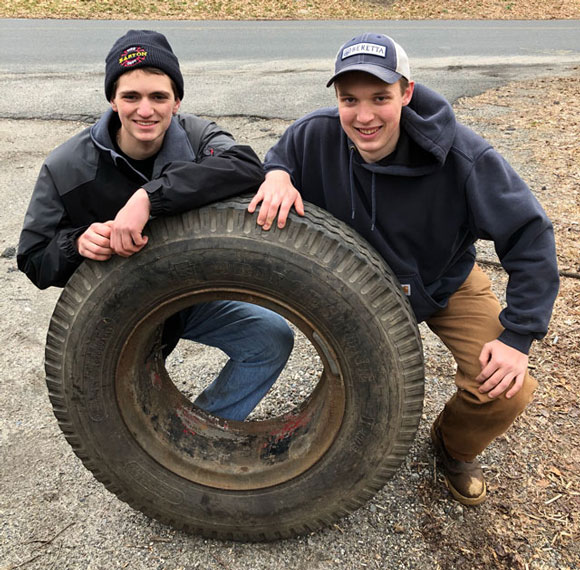
Gerrald Berrafati and Tristan Wilgan of Monroe make sure last year’s Christmas trees will stay in their new home along the Mill River at the Easton-Fairfield border. — John Kovach photo

Volunteers use Christmas trees to reshape the Mill

Gerrald Berrafati and Tristan Wilgan of Monroe make sure last year’s Christmas trees will stay in their new home along the Mill River at the Easton-Fairfield border. — John Kovach photo

Trout will soon have a better home in the Mill River thanks to a conifer revetment project.

Volunteers from Nutmeg and Mianus TU joined others in the water to anchor last year’s Christmas trees, donated by the Town of Stratford, along the banks to reshape the river.

Funds came through the Embrace A Stream program, a collaboration of Orvis and national TU, and local showings of the Fly Fishing Film Tour.

Work will continue, with continued removal of knotweed, planting of more native species, and another revetment with 2018 Christmas trees.

Volunteer to help the Mill River Aug. 19

Volunteers are needed on a major project that will improve trout habitat in the Mill River, one of the most valuable and storied wild trout streams in New England.

On Aug. 19, the Nutmeg Chapter of Trout Unlimited, working with the Town of Fairfield, will reshape the Mill River along Congress Street. Once a meandering stream, the waterway was straightened due to development. Using a technique known as conifer revetment, turns and pools will be restored to a river known as one of the best wild brook trout habitats in Connecticut.

Work will begin at 9 a.m. Volunteers should park in the dirt area across Congress Street from the river. Please be careful crossing. We should be done by noon.

Those who wish to volunteer are asked to click here to RSVP to Nutmeg TU President Rich Rosen.

Using a technique known as a conifer revetment, turns and pools will be restored to a river known as one of the best wild brook trout streams in Connecticut.

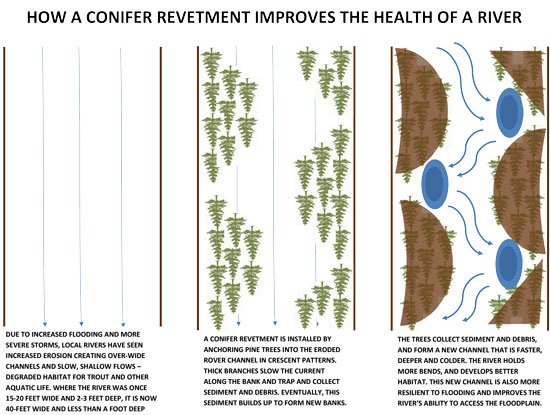
Conifer revetments use discarded natural Christmas trees to shore up the banks, collect sediment and reroute the river. Volunteers anchor now-dead evergreens in the water along the banks. There they will trap sediment and build up the bank, extending land into the water and creating a curve in the river.

“This is a great opportunity for volunteers to get their hands dirty and see the direct impact of their efforts as we work to improve the quality of the Mill River as a wild trout stream,” Nutmeg TU President Rich Rosen said. “Already we have mitigated the Knotweed problem and planted native trees and shrubs to help bring the river back to its natural state. We look forward to seeing more, larger fish making their home along Congress Street.”

In the fall of 2017, the Nutmeg Chapter received a $670 grant from the Embrace A Stream program to support removal of invasive species and shoring up of the banks of the Mill River near the Easton-Fairfield border, along Congress Street in Fairfield.

A short time later, donors contributed another $1,860.69 toward the Mill River restoration in TU’s Embrace a Stream Challenge, which rewarded chapters with bonuses for reaching certain milestones and soliciting donations..

Money was also raised when Nutmeg TU collaborated with the Candlewood Valley and Mianus chapters on showings of the Fly Fishing Film Tour in 2017 and 2018.

Help restore the Mill River Aug. 19

An effort to restore one of the most valuable and storied wild trout streams in New England is under way, and volunteers are needed for the next step.

On Aug. 19, the Nutmeg Chapter of Trout Unlimited, working with the Town of Fairfield, will reshape the Mill River along Congress Street. Once a meandering stream, the waterway was straightened due to development. Using a technique known as conifer revetment, turns and pools will be restored to a river known as one of the best wild brook trout habitats in Connecticut.

Once a meandering stream, the waterway was straightened due to development, which reduces the health of the stream and the habitat for trout and other aquatic life. Using a technique known as a conifer revetment, turns and pools will be restored to a river known as one of the best wild brook trout streams in Connecticut.

Conifer revetments use discarded natural Christmas trees to shore up the banks, collect sediment and reroute the river. Volunteers anchor now-dead evergreens in the water along the banks. There they will trap sediment and build up the bank, extending land into the water and creating a curve in the river.

“This is a great opportunity for volunteers to get their hands dirty and see the direct impact of their efforts as we work to improve the quality of the Mill River as a wild trout stream,” Nutmeg TU President Rich Rosen said. “Already we have mitigated the Knotweed problem and planted native trees and shrubs to help bring the river back to its natural state. We look forward to seeing more, larger fish making their home along Congress Street.” 

In the fall of 2017, the Nutmeg Chapter received a $670 grant from the Embrace A Stream program to support removal of invasive species and shoring up of the banks of the Mill River near the Easton-Fairfield border, along Congress Street in Fairfield.

A short time later, donors contributed another $1,860.69 toward the Mill River restoration in TU’s Embrace a Stream Challenge, which rewarded chapters with bonuses for reaching certain milestones and soliciting donations..

Money was also raised when Nutmeg TU collaborated with the Candlewood Valley and Mianus chapters on showings of the Fly Fishing Film Tour in 2017 and 2018.

Details on where to meet and how to volunteer will soon be posted, but save the date of Sunday, Aug. 19.

Field & Stream highlights Mill River

Field & Stream has listed the Mill River among “The 50 Best New Fishing Spots in America.” Click here to read the article.

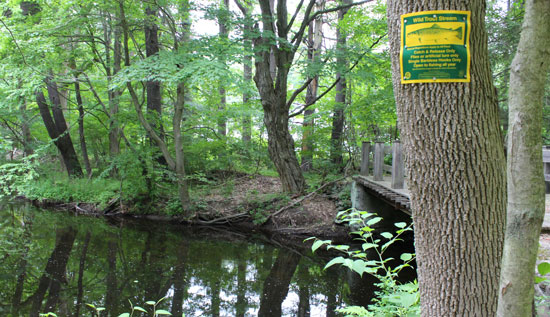
Part of the stream, running from Easton through Fairfield to the Long Island Sound, was recently reclassified by the Connecticut Department of Energy and Environmental Protection as a Wild Trout Management Area, extending the prior WTMA to the Merritt Parkway.  Single, free-swinging hooks are required.

Click here for more information on Connecticut’s Trout Management Plan.

Easton teens and Joel Barlow High School seniors Stephan Dow and Michael Waugh recently organized an led a cleanup of the Mill River. — Easton Courier

Easton teens clean Mill River

Easton teens and Joel Barlow High School seniors Stephan Dow and Michael Waugh recently organized an led a cleanup of the Mill River. — Easton Courier

Two teenagers from Easton, both fly anglers and members of the Nutmeg Chapter of Trout Unlimited, recently organized a cleanup of the Mill River.

Stephan Dow and Michael Waugh, with volunteers the recruited and led, removed some 360 pounds to trash from the river.

Click here to read a story from The Easton Courier.

Nutmeg TU thanks Stephan and Michael for their efforts.


Trout & Salmon Stamp now available

New Connecticut fishing regulations went into effect Friday, requiring some anglers to purchase a Trout & Salmon Stamp, and extending the Mill River Wild Trout Management Area and making the Mill River Trout Management Area catch and release all year.

Fees from the Trout & Salmon Stamp will go to the DEEP to support fishing activities.

Highlights of the new regulations include:

TROUT & SALMON STAMP – A trout & salmon stamp is required for any angler 16 years of age and older fishing in a Trout Management Area (TMA), Wild Trout Management Area (WTMA), Trout Park, or Atlantic Salmon Broodstock Area; or keeping trout, Kokanee Salmon or broodstock Atlantic Salmon anywhere statewide (some exceptions for waters not stocked by DEEP that are stocked by another entity). The fees for the Trout & Salmon Stamp are $5 for resident anglers who are 18 and older, $3 for CT residents ages 16 or 17 and $5 for nonresident anglers age 16 and older.  The trout & Salmon stamp is now available for purchase on the Online Sportsmen’s Licensing system. Click here to read answers to frequently asked questions about the Trout & Salmon Stamp.

MILL RIVER WTMA & MILL RIVER TMA (Easton-Fairfield) – The Mill River WTMA is extended downstream to the Merritt Parkway and the Mill River TMA is now catch-and release year round.

FARMINGTON RIVER TMA – A small portion of the West Branch Farmington River in the Riverton area from the intersection of Hogback Road and Route 20 in Hartland downstream to the gas pipeline crossing approximately four-tenths miles downstream of the confluence with the Still River in Barkhamsted will now be closed to all fishing from April First to 6:00 am on the second Saturday in April.

FISHING SEASONS  –  Alexander Lake is open to fishing year round. Baldwins Pond and Green Falls Reservoir are open to fishing from 6:00 am Opening Day through the last day of February.

CATFISH  – There is now a creel limit of 6 Channel Catfish and White Catfish in aggregate per day, except in Beaver Park Lagoon, Birge Pond, Bunnells Pond, Center Springs Park Pond, Freshwater Pond, Keeney Park Pond, Lake Wintergreen, Lakewood Lake, Mirror Lake, Picketts Pond, Rowans Pond, Mohegan Park Pond and Stanley Quarter Pond where the creel limit is 3 catfish per day.

COMMON CARP  – There is now a creel limit of 5 common carp per day, with no more than 1 fish greater than 30 inches in length, except in Trophy Carp Waters (see below).

TROPHY CARP WATERS  – Batterson Park Pond, Connecticut River (including the portions of tributaries open year-round), Squantz Pond and West Thompson Reservoir are designated as Trophy Carp Waters with a one carp per day creel limit and a 26 inch maximum length for Common Carp.

METHODS  – Tenkara fishing (a traditional Japanese method of fly-fishing without a reel) is now allowed in fly fishing areas.

ATLANTIC SALMON BROODSTOCK AREAS   – The period when broodstock salmon gear restriction applies to all species in broodstock areas is now from September 1 to March 31 (inclusive).

TROUT PARKS  – Pasture Pond at the Quinebaug Valley State Trout Hatchery, Plainfield, is now a designated Trout Park with a 2 trout per day creel limit.

 Click here to read the new regulations.

Fish close up

Single trout and salmon stamp, new WTMA approved

Revised fishing regulations, including a trout and salmon stamp, were approved Tuesday by the the state’s Regulations Review Committee.

The regulations will become effective after they are posted on the secretary of the state’s website.

The initial proposal called for separate trout and salmon stamps that could be purchased individually or in combination. That proposal was replaced by one mandating a single stamp for either trout or salmon, at a cost of $5; that was sent back for revision, resulting in the now-approved trout and salmon stamp which is $5, $3 for anglers 16 and 17 years old. Any anger who must obtain a license, regardless of if the license is free, must purchase the stamp.

A trout and salmon stamp is required for any angler 16 years of age and older fishing in a Trout Management Area (TMA), Wild Trout Management Area (WTMA), Trout Park, or Atlantic Salmon Broodstock Area; or keeping trout, Kokanee salmon or broodstock Atlantic salmon anywhere statewide.

The Mill River WTMA in Easton and Fairfield is extended downstream to the Merritt Parkway and the Mill River TMA is now catch-and-release year-round.

A small portion of the West Branch Farmington River in the Riverton area from the intersection of Hogback Road and Route 20 in Hartland downstream to the gas pipeline crossing approximately four-tenths of a mile downstream of the confluence with the Still River in Barkhamsted will now be closed to all fishing from April 1 to 6 a.m. on the second Saturday in April. This is intended to restore excitement to Opening Day.

Alexander Lake in Killingly is open to fishing year-round. Baldwins Pond in Meriden and Green Falls Reservoir in Voluntown are open to fishing from 6 a.m. Opening Day through the last day of February.

There is now a creel limit of six channel catfish and white catfish in aggregate per day, except in Beaver Park Lagoon, Birge Pond, Bunnells Pond, Center Springs Park Pond, Freshwater Pond, Keeney Park Pond, Lake Wintergreen, Lakewood Lake, Mirror Lake, Picketts Pond, Rowans Pond, Mohegan Park Pond, and Stanley Quarter Pond, where the creel limit is three catfish per day.

There is now a creel limit of five common carp per day, with no more than one fish greater than 30 inches in length, except in Trophy Carp Waters. Batterson Park Pond, Connecticut River (including the portions of tributaries open year-round), Squantz Pond, and West Thompson Reservoir are designated as Trophy Carp Waters with a one-carp-per-day creel limit and a 26-inch maximum length for common carp.

Tenkara fishing, a traditional Japanese method of fly-fishing without a reel, is now allowed in fly fishing areas.

The period when broodstock salmon gear restriction applies to all species in broodstock areas is now from Sept. 1 to March 31 (inclusive).

The DEEP found healthy populations of trout and smallmouth during electrofishing surveys of the Housatonic and Farmington Rivers (DEEP Photo)

Trout stamp on hold for now

Proposed regulations that would require purchase of a trout stamp are on hold at least into February.

The Connecticut Department of Energy and Environmental Protection posted on the Connecticut Fish and Wildlife Facebook page that the regulations had been sent back so some concerns raised by the Legislative Regulation Review Committee could be addressed.

That means continue fishing with a 2018 license until further notice, without the purchase of a stamp.

According to the Facebook post:

“Our regulations package was on the docket at yesterday’s Legislative Regulation Review Committee (LRRC) meeting (January 23). Three of the actions the LRRC can take are, approve, reject without prejudice, and reject with prejudice.

“The LRRC voted to “reject without prejudice” the regulations package, which means that there were some issues that were deemed to be “substantive concerns” that need to be addressed.

“None of the concerns raised affect the content of the regulations, except as to whether there can be a single stamp (for both trout and salmon as DEEP proposed) or two separate stamps (one for trout/kokanee and one for Atlantic Salmon).

“We are currently working on addressing those concerns to the committee’s (and their LCO reviewer) satisfaction so that the package can be resubmitted for approval at the next LRRC meeting (February 27). Stay tuned.

“So for now you can purchase your fishing license as you normally would and fish for trout as you normally would.”

Included in the proposed regulations package is extension of the Mill River Wild Trout Management Area.

Updates will be posted as they become available.

$5 trout stamp takes next step

A proposal for a single trout and salmon stamp, costing $5, is part of a new fishing regulations package sent to the state’s attorney general for review.

Once the attorney general completes review of the proposal, it will be submitted to the Legislative Regulation Review Committee for review.

The new proposal would establish a single trout and salmon stamp, which each year would cost $5. The original proposal called for a $5 trout stamp, a $10 salmon stamp, and a $12 combination stamp. After receiving online comments objecting to the fee, the Department of Energy and Environmental Protection opted to proceed with one $5 stamp.

All funds from the sale of the stamp, under state and federal law, will go toward hunting and fishing activities in Connecticut, including maintaining full production at three fish hatcheries in the state. DEEP officials held their earlier estimate of $300,000 in additional revenue, based on 60,000 trout and salmon anglers.

All anglers 16 years of age and older fishing for any species in Trout Management Areas, Wild Trout Management Areas and Trout Parks established in Section 26-112-46 of the Regulations of Connecticut State Agencies; all anglers 16 years of age and older fishing for any species in affected portions (the designated “Broodstock Areas”) of the Shetucket River and Naugatuck River; and any anglers 16 years of age and older wishing to keep trout, kokanee or broodstock Atlantic salmon (where fishing for Atlantic salmon is allowed) they’ve caught anywhere throughout the state would be required to purchase a trout stamp.

The new regulations would also extend the Mill River Wild Trout Management Area in Easton and Fairfield from upstream of the first bridge crossing below Easton Reservoir (South Park Avenue) to the Merritt Parkway, where it meets the existing Trout Management Area that continues to Lake Mohegan. Signs indicate which parts of the river are in the WTMA and which in TMA.

Click here to read the full list of amendments to the regulations.

Click here to read the DEEP’s explanatory statement.

Click here to read the notice of decision.