Changes coming to sea-run trout program

TU-SEA-RUN-210

By Ron Merly

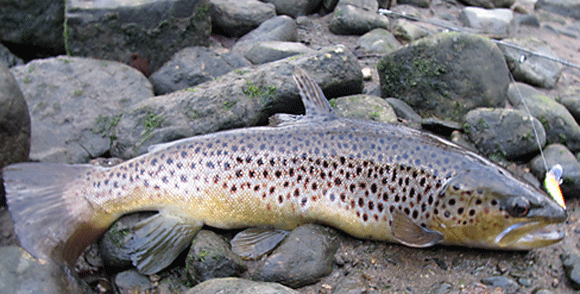
State fisheries biologist Tim Wildman has not been happy with the number of annual returns of sea-run brown trout that are currently released into Connecticut estuaries. Seeforellen browns from Germany, which are indigenous to their lakes, are raised at Connecticut’s Kensington Hatchery and released into some lakes and reservoirs, but are also used for stocking sea-run brown trout as well. These fish do not have a dianadromous lineage: In other words, they do not run out to sea and return, they live in lakes.

Wildman resurrected the sea-run brown trout program in Connecticut in 2000 when he saw trout being destroyed as too many were being raised to release into the state’s waters. He took the excess fish and began releasing them into several estuaries around the state. (See the Flyfisher’s Guide to Connecticut for more info on where to find them).

After approximately 10 years of light returns, Wildman began to search European countries for natural strains of sea-run brown trout. There are many, however the standards for importing fish into this country are very strict so that diseases are not brought into our waters. After years of research and the convincing of his bosses, he has successfully imported a natural sea-run brown trout strain from a country that borders the Baltic Sea. Wildman asked that I not disclose the country so I will not.

This exciting change will begin to occur this year (2014), so returns should be seen in 2 to 3 years. These fish have a vast range that naturally covers an area about ths size of Long Island Sound. This strain of brown trout should return at an average of 6 to 8 pounds, but some grow as large as 15 pounds in the Baltic. Wildman hopes to establish significant returns of the browns and would like to see Connecticut become a sea-run trout fishing destination. Tim also said that not one fish was lost during the importation process so they appear to be a very hearty strain.

Lets keep our fingers crossed!! Thanks to Tim for all of his effort and we wish him well in this endeavor.

Prosek show to open in New Britain

TU-PROSEK-SHOWS

Artist and Nutmeg TU member and supporter James Prosek will be part of a number of major shows in coming months.

“Teaming with Nature: James Prosek” is open in The Forrest E. Mars, Sr. Exhibit Hall at the National Sporting Library & Museum in Middleburg, Va., through Jan. 30.

“Wondrous Strange,” featuring much of Prosek’s recently closed exhibit at the Addison Gallery of American Art, opens at the New Britain Museum of American Art Feb. 22 and is on exhibit through June 8. The opening reception will be held Feb. 22.

“The Peacock and the Cobra: James Prosek” continues among the “Arts of South Asia” in Wood Gallery 227 at the Philadelphia Museum of Art until April.

Works by Prosek are also on display at the Trafo Contemporary Art Museum in Budapest through Jan. 26.

Information can be found at troutsite.com.

Beardsley Zoo seeking young naturalists

Connecticut’s Beardsley Zoo is looking for high school students who deeply love nature for the Conservation Discovery Corps.

Students who are accepted will have the opportunity to work side by side with field biologists, study the role of zoos in conservation, help educate the zoo’s visitors and more. The program usually includes two or three day-long trips, visits to other zoos and aquariums, etc.

Click HERE to watch a video about the Conservation Discovery Corps.

A one-time processing fee of $65 is assessed for students who are accepted for the grant-supported program.

Applications should be filed as soon as possible. Click HERE for information and to download an application.

Weekend classes start in February; the opportunity for greatest involvement is during the summer.

Raw sewage flows into Nagatuck River

Environmental officials are working to assess the damage after tens of thousands of gallons of untreated wastewater flowed into the Naugatuck River after a manhole collapsed on Christmas Day in Seymour.

The Naugatuck flows into the Housatonic, which empties into the Long Island Sound. The effects on the ecosystems have yet to be determined.

Click here to read additional coverage.

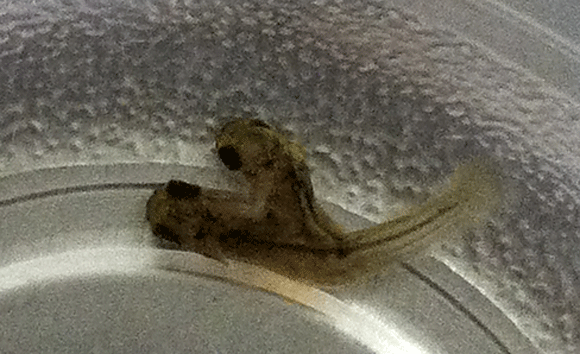
Conjoined trout hatched for the Trout in the Classroom program Meadowside School in Milford.

Rare find in TIC hatch

Conjoined trout hatched for the Trout in the Classroom program Meadowside School in Milford.

The Trout in the Classroom program at Meadowside School in Milford, sponsored by Nutmeg TU, got a surprise when their eggs recently hatched.

Fifth grade teacher Jason Cicero sent this photo of conjoined fry to Gian-Andrea Morresi, TIC coordinator for the Nutmeg Chapter of Trout Unlimited.

“The fish are doing great but when I checked them yesterday I noticed something amazing and wanted to share it with you. We have conjoined twins in our nursery,” Cicero wrote. “I hope the picture comes across so you can see this, it’s amazing! “

“That is different,” DEEP biologist Neal Hagstrom wrote. “Usually you have them belly to belly and often one embryo will overgrow the second before they are this developed.  Sometimes all that is left is an extra fin. Looks like completely separate digestive, neural and circulatory system. Neat shot.”

Trout in the Classroom is TU’s cornerstone environmental education program. Students learn about the importance of clean, cold water as they raise trout from eggs, ultimately releasing them into the wild.

Magazine renewal scam targets TU members

Trout Unlimited is alerting members across the country to a scam.

A company called Platinum Publishing sent renewal invoices for TROUT magazine for $79.95 to some of TU members.

“Please be advised that this is a scam and did not originate from TU’s offices,” according to an alert in the most recent Lines and Leaders.

Members are advised to not respond to these invoices, “but rest assured tu.org and our Woolly Bugger, WV, post office box are fully operational, secure and ready to process dues and gifts.”

Construction of bypass under way at Tingue Dam

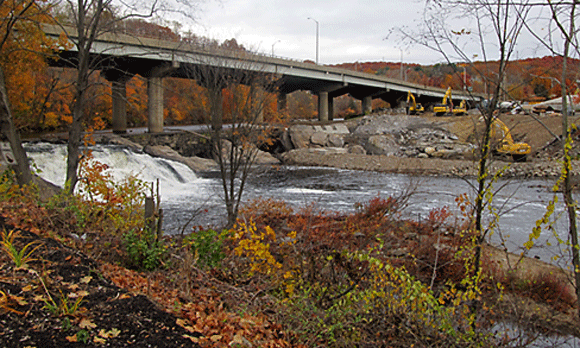
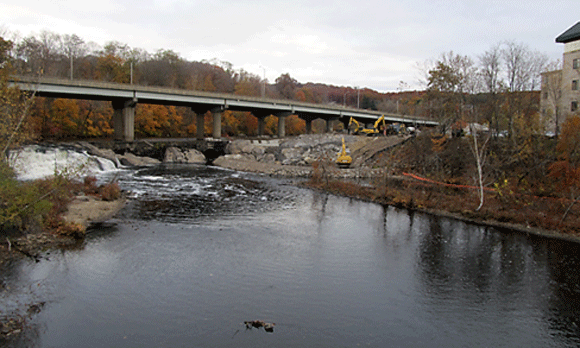
Ron Merly captured this image of work on construction of a fish bypass at the Tingue Dam in Seymour.


Work on the fish bypass at the Tingue Dam in Seymour continues along the Naugatuck River.

The Tingue Dam bypass is one of seven environmental projects that officials have chosen to fund with $2 million from the 1999 Housatonic River settlement.

The bypass will increase habitat for migratory fish, such as river herring via construction of a bypass channel to facilitate fish movement around the dam on the Naugatuck River as far north as Thomaston. When complete, the project will immediately restore access to 32 miles of habitat essential to spawning of numerous species including shad, alewife and American eel.


Nymphing demystified on Nov. 19

Bill Keister will take the mystery out of using nymphs to catch trout at the Nov. 19 meeting of Nutmeg Trout Unlimited 217.

The meeting will be held from 7-9 p.m. at Port 5 Naval Veterans, 69 Brewster St., Bridgeport.

“Is nymphing a mystery?  Could your nymphing be more effective?” Keister writes. “The presentation is conducted as workshop where interaction is encouraged.  The program starts with definitions and explanations of long line and high stick nymphing. Particularly effective flies are described. Rods, lines, leaders, strike indicators and methods to get flies down are covered. The importance of drag free drifts is explained.  The causes of drag are described.  Casts and method for eliminating drag are covered. Questions will be answered at any time during the presentation.”

Bill Keister is a Federation of Fly Fishers (FFF) certified Master Casting Instructor (MCI). He ties his own flies and makes most of his fly rods. He has caught trout and salmon in Labrador, Newfoundland, Kamchatka, the Kola Peninsula, Alaska, Chile and three additional Canadian provinces and fifteen US states. Each spring he catches 200 to 300 fish nymphing on Connecticut’s Salmon River.

DEEP reports more salmon stocked

DEEP began spawning salmon at the Kensington Hatchery last week and approximately 100 spawned salmon were stocked out earlier this week in the Naugatuck River (upper – 25 fish, lower – 25 fish) and Shetucket River (50 fish).

These fish range in size from 2 to 15 pounds, and average 10 pounds each.

These stockings will bring the number of broodstock Atlantic salmon stocked this fall to approximately 1,800.

CLICK HERE TO READ THE DEEP WEEKLY FISHING REPORT.