TU attracting female anglers

Trout Unlimited is offering a free introductory membership for female anglers.

For the next year, women who join will receive all the benefits of a paid membership:

•            1-year subscription to TROUT magazine

•            16-month TU calendar (mailed in the fall)

•            official TU membership card

•            car rental & hotel discounts

•            TU decal

•            Local chapter membership

And another, less tangible benefit: the pleasure of knowing you’re part of a growing community of women who enjoy angling and want to keep America’s rivers cold, clean and fishable.

This offer is available to new members only. Not applicable for existing members.

Click here to join.


Salmon stocked in the Naugatuck

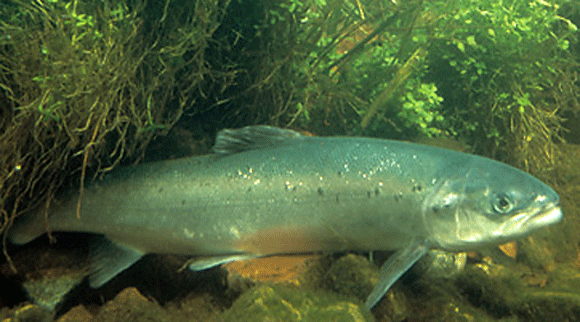
The Connecticut DEEP has stocked Atlantic salmon in the Naugatuck River. (Photo by William Hartley/U.S. Fish & Wildlife Service)

Connecticut’s Department of Energy & Environmental Protection has begun the 2013 autumn stockings of broodstock Atlantic salmon.  DEEP’s Inland Fisheries Division recently released 300 salmon into the Naugatuck River and Mount Tom Pond.  Later this week, DEEP will release 300 salmon into the Shetucket River and Crystal Lake.

“Atlantic salmon are renowned for their size, beauty and fighting ability,” said Peter Aarrestad, Director of DEEP’s Inland Fisheries Division.  “The Atlantic salmon recreational fishery has become quite popular, and catching one of these large leapers provides a thrilling experience for anglers.”

The Atlantic salmon being stocked in Connecticut were raised in the Kensington State Fish Hatchery and are the progeny of sea-run fish that returned to the Connecticut River.  Salmon at this hatchery were raised to provide eggs for the Connecticut River Atlantic Salmon Restoration Program that began in 1967.  Since 1992, surplus and spawned fish from this program were made available to provide a recreational fishery for Connecticut anglers.

Click here to read more in The Valley Gazette.


Streamflow changes proposed in some rivers

DEEP has taken the first step toward implementation of streamflow protections. This step is the classification of streams within a given watershed as Class 1 to Class 4 (high quality to terrible quality). The classification determines the level of flow protection that will be accorded under the regulation.

The Connecticut Council of TU said DEEP has done an outstanding job in creating maps that present most of the information essential to understanding the classifications and reasons for the classifications. It has started with the eastern portion of the state.

“It is very important for friends of rivers all across Connecticut to review and comment on these maps,” according to a notice from the council. “You may want to advocate for certain adjustments to the rationale or process of classification.”

The DEEP has prepared maps of proposed stream flow classifications for the Southeast Coastal, Pawcatuck and Thames Major River Basins, available online. The maps include river and stream segments in Andover, Ashford, Bolton, Bozrah, Brooklyn, Canterbury, Chaplin, Colchester, Columbia, Coventry, East Lyme, Eastford, Franklin, Griswold, Groton, Hampton, Hebron, Killingly, Lebanon, Ledyard, Lisbon, Mansfield, Montville, New London, North Stonington, Norwich, Old Lyme, Plainfield, Pomfret, Preston, Putnam, Salem, Scotland, Sprague, Stafford, Sterling, Stonington, Thompson, Tolland, Union, Vernon, Voluntown, Waterford, Willington, Windham, and Woodstock.

Public information sessions will be held at:

Northeast CT Council of Governments, 125 Putnam Pike, Dayville, on Tuesday, Oct. 15, in two sessions: 2-4 p.m. and 6-8 p.m.

Southeastern CT Council of Governments, 5 Connecticut Ave., Norwich, on Wednesday, Oct. 16, in two sessions: 2-4 p.m. and 6-8 p.m.

A short presentation on how the stream flow classification maps were developed will be given, copies of the maps will be available for inspection, and Department staff will be on hand to answer questions at these information sessions.

The proposed stream flow classification of a stream or river segment is based on ecological conditions and human use characteristics, and determines flow management goals and applicable flow standards for that segment. Proposed stream flow classifications were developed using known information on factors indicative of the degree of human alteration of natural stream flow, environmental flow needs and existing and future needs for public water supply.

The public may submit additional information or comments for the Commissioner’s consideration on the proposed classification of a specific river or stream system pertaining to, but not limited to: (i) the factors for consideration in the regulations; (ii) the impact of the proposed classification on any prior investment made to develop a permitted or registered diversion and the alternatives, if any, to the diversion including cost factors and feasibility of such alternatives; (iii) the relationship of an existing or proposed diversion to economic development or jobs; and (iv) the practicality of, and potential for, achieving ecological benefit from restoring streamflow to the specific river or stream system. Written comments may be submitted by email to deep.streamflowclass@ct.gov, or may be mailed to Robert Hust, Department of Energy & Environmental Protection, Bureau of Water Protection and Land Reuse, 79 Elm Street, Hartford, Connecticut, 06106-5127. The Department is accepting additional information or written comments on the proposed Streamflow Classifications until Tuesday, Dec. 31, 2013.

Additional information on the Stream Flow Standards and Classifications is available on the Department’s website at: www.ct.gov/deep/streamflow . Anyone requiring more information may contact the Department by email at deep.streamflowclass@ct.gov or by phone at 860-424-3020.

The Connecticut Department of Energy and Environmental Protection is an Affirmative Action and Equal Opportunity Employer that is committed to complying with the Americans with Disabilities Act. To request an accommodation call 860-424-3194 or email deep.accommodations@ct.gov.

The Rivers Alliance will also help with questions. Information can be found at www.riversalliance.org.
Nutmeg TIC featured in column

Fishing columnist Martin Armstrong recently shared an account of a Trout in the Classroom event at Connecticut’s Beardsley Zoo.

“This is fun! I caught six fish,” boasted a very happy Danielle Nichols as she reeled in her last fish from Bunnells Pond in Bridgeport. 

Danielle, age 13, and 15 other students from Bridgeport’s Park City Prep and Bridge Academy are participants in the Beardsley Zoo’s Trout In The Classroom (TIC) program. Recently the students teamed up with the Connecticut Aquatic Resources Education (CARE) program for a day of hands on learning and some fishing.

Click here to read Armstrong’s column.

Chris Cryder

Nutmeg TU meets Oct. 15

Chris CryderNutmeg TU 217 will resume regular meetings Tuesday, Oct. 15, at 7 p.m. at Port 5 in Bridgeport.

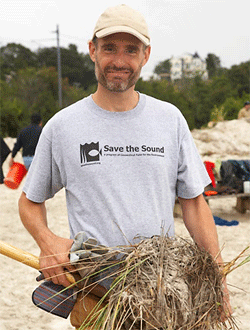
Chris Cryder, Special Projects Coordinator  for Save the Sound, will discuss “The Forage Fish that Feed the Sound’s Ecosystem.”

Connecticut, Cryder said, is a leader in opening riverine habitat for migrating forage fish such as river herring and shad. To date, 43 fish ladders have been built (such as Save the Sound’s latest on the Pequonnock) and 12 dams have been removed.

However, when the juvenile river herring that are born in Connecticut rivers and streams return to the ocean to mature, they are being incidentally caught and killed in great numbers in the commercial trawling industry for Atlantic herring. There are methods that can be employed to minimize the bycatch of river herring, but currently forage fish do not have adequate protections under the Magnuson-Stevens Act (MSA), the law that governs fisheries in U.S. Waters.

“We believe this needs to change,” Cryder said.

Nutmeg TU members will learn about the status of forage fish in Connecticut, hear updates on restoration work on the Pequonnock River (and others), and hear how they can assist with strengthening the Magnuson-Stevens Act.

Chris Cryder has worked for Save the Sound, a program of the Connecticut Fund for the Environment, for the past seven years. He has managed habitat restoration and green infrastructure projects, and has coordinated land preservation and watershed planning initiatives. He coordinated the Pequonnock River Initiative in 2010-11, which resulted in the creation of an EPA watershed-based plan for the river.

Cryder has a biology degree from The Pennsylvania State University, and a master of health services administration from The George Washington University.

He resides in Old Saybrook.

A blog by Cryder can be found at http://greencitiesbluewaters.wordpress.com/2013/09/04/the-forage-fish-that-feed-the-sounds-ecosystem.

James Prosek to be guest speaker at Pequot Library 9/29

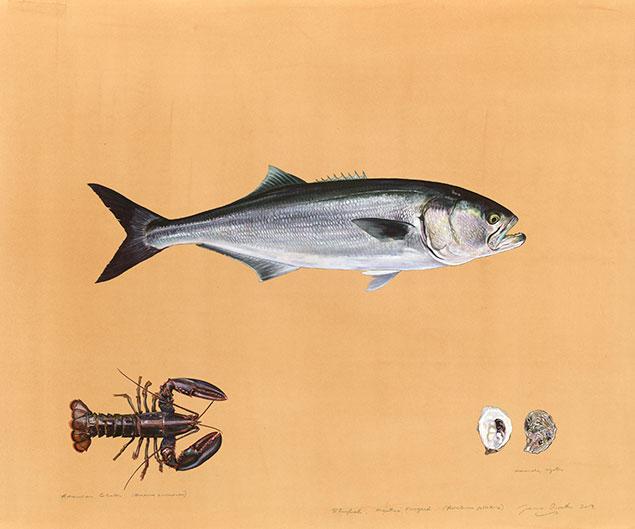
James Prosek - bluefish


James Prosek will be the guest speaker at the Connecticut Fund for the Environment/Save the Sound Annual Meeting to be held at Pequot Library in Southport, Connecticut on Sunday Sept 29, from 1-3 pm.

The mission of the Connecticut Fund for the Environment and its program Save the Sound is to protect and improve the land, air and water of Connecticut and Long Island Sound. It uses legal and scientific expertise and brings people together to achieve results that benefit our environment for current and future generations.

Mr. Prosek will be signing copies of Ocean Fishes afterward:

“I am not painting fish to represent a species in a field guide; I am painting an individual fish that I had a personal experience with—The paintings are not as much about the fish as our relationships as humans to the fish—you could even call each one a self-portrait. As anyone who has spent time on the water knows, a fish is a dynamic, colorful, always-changing organism, lit by some internal light that rapidly flickers out as a fish dies. No two fish look the same, and no individual fish stays the same for any particular length of time. Therefore, a painting of a fish cannot be an official representation, but an interpretation only.”
– James Prosek

In the tradition of his acclaimed Trout: An Illustrated History, renowned naturalist, artist, and fisherman James
Prosek captures 35 of the most pursued saltwater fish—from striped bass to tarpon, swordfish to bonefish—as well
as many creatures that share these marine ecosystems through highly detailed watercolors painted specifically for
this volume. OCEAN FISHES is his personal tribute to marine beauty unlike any published before—based on travel,
intense observation, work with scientists, and stories of those who know the fish most intimately, fishermen both
recreational and commercial. It is also the author’s quiet conservation statement; in showing the beauty and
monumentality of these fish, Prosek is urging us to appreciate and preserve what we have before it is lost forever.

Each painting reflects Prosek’s individual experience with a single fish. These paintings give the reader a privileged
view of a fish fresh from the ocean when its changing colors first glint in the sun—a view ordinarily glimpsed only
by the fishermen on the boat. The artist traveled the Atlantic, from Nova Scotia to the Cape Verde Islands, to
experience first-hand each species just out of the water before the fish lose their true colors.

ABOUT THE ARTIST AND CONTRIBUTORS: James Prosek made his authorial debut at 19 years of age with Trout:
An Illustrated History, earning him the moniker “the Audubon of the fishing world” by The New York Times. Prosek
is a regular contributor to The New York Times and won a Peabody Award in 2003. He lives in Easton, Connecticut.
Peter Matthiessen is a two-time National Book Award–winning author—for The Snow Leopard, 1980, and
Shadow Country, 2008. His work, Blue Meridian, is thought to have inspired Peter Benchley to write Jaws in 1974.
His 1988 book Men’s Lives is an eloquent portrayal of the disappearing way of life of the Long Island fisherman. He
lives in Sagaponack, New York. Robert M. Peck is Curator of Art and Artifacts and Senior Fellow of the Academy
of Natural Sciences of Philadelphia, and is also a writer, naturalist, and historian who has traveled extensively
worldwide. Christopher Riopelle is the Curator of Post-1800 Paintings at The National Gallery, London. He has
held curatorial positions at the Philadelphia Museum of Art and the J. Paul Getty Museum, CA , and has curated
exhibitions on Renoir (1990 and 2007); Rodin and Michelangelo (1996–1997); Portraits by Ingres (1999–2000), and
a forthcoming exhibition on Richard Hamilton (2012) among others.

Sept. 17 meeting canceled

There will be no meeting Tuesday, Sept. 17. However, the October meeting will take place as planned on Tuesday, Oct. 15, at 7 p.m. at: Port 5 Naval Veterans, 69 Brewster Street, Bridgeport, CT 06605.

Nutmeg TU’s dedicated volunteers see the importance of focusing their finite energies and time on TU’s mission. We are implementing a Mill River Improvement Plan,  removing invasives, restoring natives and improving wild trout habitat. The chapter’s Trout In the Classroom environmental education program touches the lives of hundreds of K-12 students in 10 area schools plus Connecticut’s Beardsley Zoo.

These are accomplishments which we’re proud about. We’re excited about what the chapter has accomplished so far; building on a tradition of accomplishments by active volunteers. We intend to do more than ever about conservation and education. We hope you too will want to be a part of in any big or small way.

Tight lines,

The Board of Directors, Nutmeg chapter Trout Unlimited (#217)

Nutmeg TU Board of Directors to meet

The Nutmeg TU Board of Directors has announced its fall meeting schedule.

All meetings are held at the Fairfield Library, 1080 Old Post Road, Fairfield.

The fall schedule includes:

Thursday, Sept., 12 7 p.m., Children’s Room A&B

Thursday, Oct. 10, 7 p.m., Jennings Room

Thursday, Nov. 14, 7 p.m., Jennings Room

Meetings are open to the public.

Beneath the surface of the lower Mill River lies lead and other waste from the former Exide battery plant. The company has announced a plan to clean the river, but some neighbors and conservationists fear what the work could stir up. (Fairfield Sun/Shawn O'Sullivan)

Fairfield gives green light to Exide cleanup

Beneath the surface of the lower Mill River lies lead and other waste from the former Exide battery plant. The company has announced a plan to clean the river, but some neighbors and conservationists fear what the work could stir up. (Fairfield Sun/Shawn O'Sullivan)

Plans for cleanup of the Mill River are once again moving forward. In a joint session on Aug 1, The Harbor Management, Shellfish and Conservation commissions all voted to end Fairfield’s intervention in planning the removal of contaminants left in the Mill River by the former Exide battery plant.

In January of this year, after an information session held by DEEP and Exide, both Fairfield’s Shellfish Commission and local advocacy group Fairfielders Protecting Land and Neighborhoods (FairPLAN) requested a public hearing on one of the permits required for Exide’s remediation activities. This delayed DEEP in approving Exide’s plan, and led to a new approach.

Click here for the Fairfield Sun story.