July 9 board meeting canceled
The Board of Directors meeting scheduled for Tuesday, July 9, has been canceled.
The next board meeting will be held Thursday, Aug. 8.
The Board of Directors meeting scheduled for Tuesday, July 9, has been canceled.
The next board meeting will be held Thursday, Aug. 8.
To help gather manpower for another major push against the knotweed choking the side of the Mill River, Nutmeg TU will hold a cutting day on Saturday, June 29, from 10 a.m. to 2 p.m. along Congress Street.
If you can attend and pitch in for any part of that span, stop by and relieve stress by chopping down an invasive that threatens native species and the flow of the river itself.
We’ll have some food and beverages so members can catch up with each other, telling fish tales and exchanging ideas about this and other projects or group outings Nutmeg can take part in.
If you have not done so yet, drive down Congress Street and see how much progress on removing knotweed small groups have made. Then come out and join the party on June 29.
If you can spare just an hour, it will make a difference. Please RSVP by posting a comment on the events calendar on the website so we know how many hot dogs to buy.
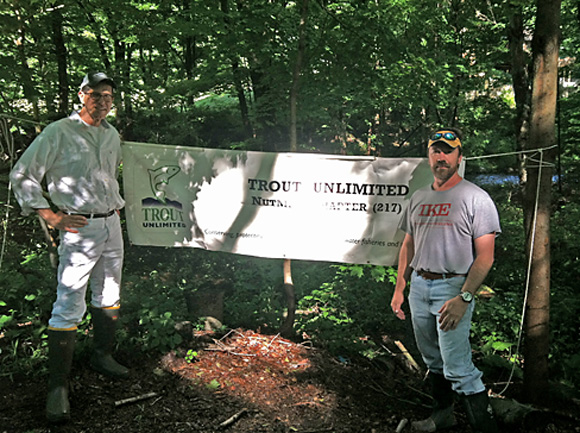
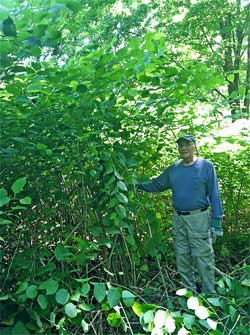
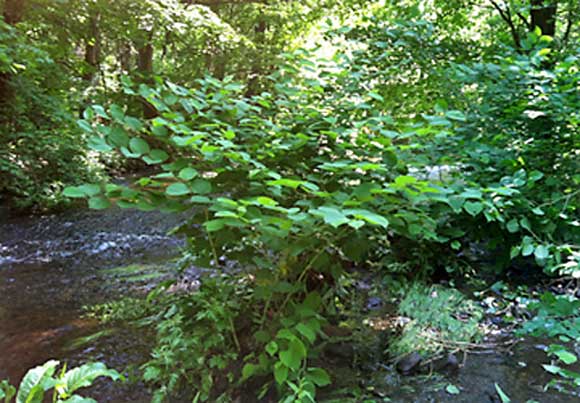
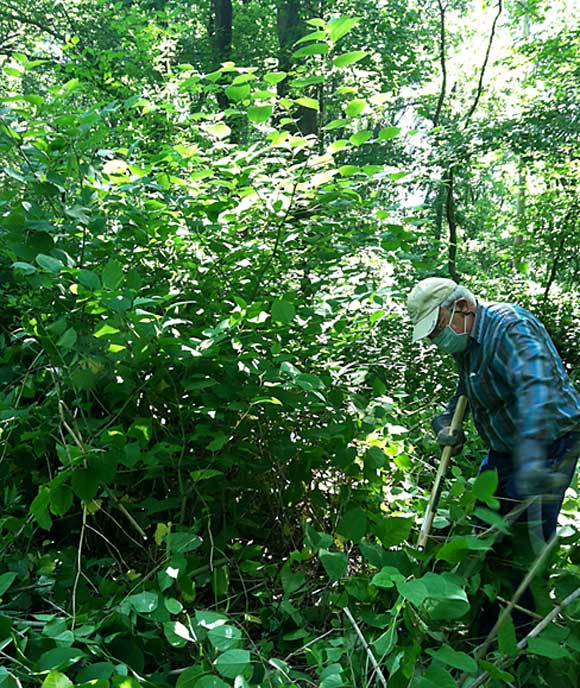
Volunteers from Nutmeg TU, and their supporters, will return to the banks of the Mill River along Congress Street in Fairfield Saturday and Sunday, June 15 and 16, to continue to hack away at Japanese knotweed that is overwhelming that natural habitat for native plants and beginning to threaten the river itself (see above).
Working in pairs, a handful of members and a conservationist have cut down the weed, which can approach 10 feet in height, the first two weekends in June. Other than a large bank on a steep slope that will require more help, the tandems have cut down much of the knotweed from the bridge where the Mill River winds under Congress Street to the eastern edge of the Mobil station on the southbound Merritt Parkway.
Thanks to Mike Abramowitz, Phil Jacques and Gian-Andrea Morresi of Nutmeg TU, and Mike Rowinsky, who organized the recent Rooster River cleanup, for pitching in.
Volunteers are needed for morning and afternoon sessions this weekend.
To sign up, go to “Events” under “Get Involved” at nutmegtrout.org. In the June calendar there are 2 sessions listed for each weekend day in June.
Click on any session you wish to sign up for. The event window will open, and below the listing you will see “Leave a reply.” Enter your name and email address in the fields marked with an asterisk, then type “John Doe can attend for the entire session” or “John Doe is available from 9 to 11 a.m.” in the window marked comment. Include a cell phone number where you can be reached if there is a schedule change.
Click “Post Comment” to complete the process. THAT’S IT!!
Please sign up for any and all sessions when you may be able to help by clicking on that particular morning or afternoon session. The process must be repeated for each session you can attend.
Also indicate the maximum number of sessions you can attend so we do not overbook you.
Thanks for your help with the crucial conservation project
The New Haven Register reports that Connecticut, having lost its partners, is reducing its salmon stocking program after 40 years.
Click here for the full story.
Nutmeg TU members took to the woods over the past week to begin the removal of invasive Japanese Knotweed from land between Congress Street and the Mill River.
Tuesday, President Charles Petruccelli and Vice President Bob Campbell ventured in to make the initial cuts and determine the scope of the project.
Saturday Mike Abramowitz answered the call for volunteers and join John Kovach. The two cut down most of the largest bank of knotweed closest to where the river passes under Congress Street.
Sunday Campbell and Kovach bagged much of the cuttings during a 3-hour period. Some remains to be bagged, but 14 42-gallon bags of knotweed await pickup by the Town of Fairfield.
Nutmeg TU needs more than a few good anglers to join its war against an invasive species threatening the crown jewel of Nutmeg’s territory, the Mill River.
With the full support of the Fairfield Conservation Office, Nutmeg TU is working Saturdays and Sundays in June to stem the invasion of Japanese knotweed on the banks of the Mill River along Congress Street. Not only is the invasive species pushing out indigenous plants on the ground: The rapidly spreading weed is taking root in the stream itself, on rock piles and gravel bars. (Click here to read more about knotweed.)
Be part of the solution
Nutmeg is about to fire a major salvo in a multi-pronged battle that will take at least a year to win.
During June, volunteers must physically cut all of the knotweed along Congress Street, and drag the remains to the street for pickup. In the fall, when the plant is ready to reproduce, an herbicide safe for use near rivers will be sprayed on the weakened plants. If the stand is successful, then a second cutting next spring should turn back the invader and allow Nutmeg to begin to plant native species along the Mill River.
A recon team earlier this month determined how to battle the menace and got a handle on what it will take to get the job done. This work cannot be done by a handful of people. Nutmeg needs more members to answer the call, up to 20 volunteers on any scheduled cutting.
Sessions are scheduled each Saturday and Sunday in June, from 8:30 a.m. to 12:30 p.m. or from 1 to 4 p.m. An email address is being established so volunteers can register, but drop-ins are welcome especially the weekend of June 1-2.
All volunteers must read this safety advisory.
We’ve been permitted by the town to reclaim the habitat. It’s up to us to show that we’re up to the task, and people are watching.
Charles Petruccelli, President
The University of Connecticut is seeking an additional water supply for a potential technology park in Storrs and increased development in the town of Mansfield, and has solicited a number of proposals. The plan submitted by MDC would draw water from a reservoir in the Farmington River watershed, west of Hartford, and pipe it to Storrs.
The Connecticut Fund for the Environment, Save the Sound, Trout Unlimited and other conservation groups are concerned that this would violate the state’s Plan of Conservation and Development by encouraging sprawl in rural areas, that it moves water from one watershed to another, and that it doesn’t conform to a regional water plan. Following these plans is one of the most important ways to make sure our waters stay healthy and adequate to support our communities and wildlife. (Read more in the groups’ blog post.)
Please join in asking UConn to find a more sustainable way to meet its water needs, and in calling for statewide planning that will protect our critical water resources.
Step 1: Call UConn
Call the office of UConn President Susan Herbst at 860-486-2337 .
Sample script:
“Hi, my name is ___, from ___. I’m calling to ask President Herbst to find a solution to UConn’s water needs that doesn’t pull water from the Farmington River Watershed. Water planning is an issue that affects all Connecticut residents. Please make UConn a leader by choosing a solution that supplies only as much water as is needed, protects the integrity of the Farmington and Thames watersheds, and conforms to the state’s Plan of Conservation and Development. Could you pass my message along? Thank you!”
Step 2: Sign the Petition
Voices for the Farmington River has created a petition asking for a smarter water solution for UConn. Please join the over 1,000 Connecticut residents who have already spoken up for sustainable water planning. Then please share it with your friends. Let’s see how many signatures we can get before June 7, when the petition will be ended and delivered to Governor Malloy and President Herbst.
The annual Open House at the Rainbow Dam Fishway will be held Saturday, June 1, from 10 a.m. until 3:30 p.m.
This is the largest fishway in Connecticut and there is a good chance to see migrating salmon, shad, bass, trout, sea lamprey, and other marine life, according to Stephen Gephard ,supervisor of the Diadromous Fish Program and Habitat and Conservation Enhancement Program for the Inland Fisheries Division of the Connecticut Department of Energy and Environmental Protection.
There is an underground viewing window that is normally off-limits to the public, but on this day the public is invited down to watch fish swim by.
Those using GPS to find the fishway should try 400 Rainbow Road, Windsor. You still may have to look for our sign on the south side of the road. Otherwise, take I-91 to Exit 40 and Rt. 20 toward the airport. Take the “Hamilton South” exit, turn left and proceed to the intersection at Rainbow Road. Turn right and look for our signs to the left within a ¼ mile.
“Given the river conditions and the weather forecast, I bet there is a good chance fish will be actively migrating on Saturday,” Gephard said in an email.
Connecticut’s landscape is dotted with approximately 5,500 dams, most of them on private property. The state currently has only one full-time dam inspector — not nearly sufficient to ensure that the dams are sound, according to the Connecticut Fund for the Environment and Save the Sound.
HB 6441, An Act Concerning the Dam Safety Program, would let landowners have dams on their property inspected by qualified private sector engineers instead. The idea has wide support, but session is coming to an end and we need your help in making sure the bill gets a vote soon!
Please call one or more of these leaders today:
• Rep. Brendan Sharkey, Speaker of the House: 860-240-8500
• Rep. Joe Aresimowicz, House Majority Leader: 860-240-8489
• Rep. Linda Gentile, Environment Committee co-chair: 860-240-8585
Callers will reach an aide or an answering machine. Here’s a sample script you can use:
“Hi, my name is ___ from _[town]_. I’m calling to ask Representative ___ help make sure HB 6441, An Act Concerning the Dam Safety Program, comes up for a vote soon. This bill will improve public safety and encourage the removal of old and unnecessary dams, and it should not be held up any longer.”
Can you do more? Call your own representative and ask him or her to support HB 6441 in two ways: first, by asking their leadership to make sure the bill is brought up for a vote, and second, by voting yes on HB 6441 once it’s called. Call the House Democrats switchboard at 800-842-8267 or the House Republicans switchboard at 800-842-1423 and ask to be connected to your representative by name. If you don’t know who your state representative is, you can look them up and find their phone number on the CGA website or at www.votesmart.org.
The policy change in HB 6441 is a simple measure that will have multiple benefits:
• Protecting the public from the hazards of dam failure
• Protecting landowners from liability
• Creating steady jobs for private sector engineers
• Encouraging the removal of unnecessary dams, which restores natural flow to rivers, prevents the buildup of toxic sediments, and allows fish access to their upstream spawning grounds
Read more in this factsheet.
Mike Humphreys, a fishery biologist for the state DEEP, provided the Housatonic Fly Fisherman’s with the attached chart at a recent meeting.
Humphreys spoke of this chart at the HFFA’s April membership meeting. This will help anglers identify the types of stocked fish they catch and release up on the Housy.
Mike is always looking for angler feedback, which helps to assess holdover rates, by species and length stocked. This helps the CTDEEP determine the best types, sizes and periods to stock trout, Dan Keney of the HFFA said.
The chart covers data from 2011 to the pending stocking this fall.
The identification tag mark feedback also helps measure trout holdover rates and the impact of the HFFA’s annual thermal refuge work and other club conservation efforts.