Exciting events open to all

Nutmeg TU President Rich Rosen

Fellow fishermen and conservationists:

Wow!  Our February board meeting just ended and I am excited!  Your Board really stepped up and put together a great agenda for the next five months.  I needed to share our plans with you so here goes!

Our speaker agenda will bring us new ideas and hints for local fishing.

  • February 20  Jimmy O is going to tell us about Winter striper fishing on the Housie.
  • March 20  Tim Barry from DEEP will enlighten us about stocking plans, DEEP’s new fish finding tech, and the new expanded TMA on the Mill River.  Plus much more!
  • April 17  Jeff Yale from Regional Water will talk about fishing Lake Saltonstall.  The lake is easily accessible (visible from Rt. 95) and loaded with a wide variety of fish, including Walleye, Bass, trout and much more.
  • May 15  Sonny Yu talks fly fishing for American Shad.  We’ll have a trip the Saturday after this meeting to fish for Shad on the Mill River in Fairfield (who knew?)

Kudos to John Kovach for creating such an exciting agenda. The meetings are always at Port 5 in Bridgeport and pizza and drinks are available. We also have some fun auction items available at every meeting to raise some funds to support our programs.

In March we start our fishing trips and hands on activities.  All of the trips will be led by one or more of our experienced fishing leaders from our Board and membership.

  • March 31 – Trout fishing the Saugatuck on Ford Road.
  • April 21 (World Fish Migration Day) –  This is a big one!

In cooperation with Beardsley Zoo we will have a Pequonnock River Day.

Activities to include:

    • River cleanup.
    • River walk and insect study.
    • Bird of Prey animal encounter.
    • Fly casting clinic (5 LL Bean donated rods will be available for use).
    • Tree planting.
    • And of course, we will cap the day off with some fishing on the Pequonnock.

             Get your hands dirty, learn to fish and catch some fish. Come for all or part of the day.

  • May 20 – Shad fishing on the Mill River in Fairfield.
  • May 23 – Trout fishing at the Limestone Club (fee charged, space limited – email me to register rhrosen@aol.com)
  • May 26 – Striper fishing on the Housatonic at the Audubon center in Milford.
  • June 24 – Trout fishing on the Farmington.

On the Conservation front we resume our work on the Mill River at Congress Street. Watch your emails for the date.  Many hands will be needed as we work to deepen the river by anchoring Christmas trees to channel the river.  Last year we planted hundreds of trees here.  This next important phase will insure the Mill river will continue to be a premiere fishing spot for years to come.  It can’t be done without member’s like you helping.

I hope you agree that we have some great stuff lined up and member participation is key. All of the meetings and trips are free (except for the Limestone outing) and the public is welcome.

Rich Rosen

Nutmeg Chapter President
Fishing roundtable Jan. 16

UPDATE: Tonight’s meeting will be held as scheduled at 7 p.m. at Port 5, 69 Brewster St. Bridgeport.

Ever wonder about how to get started fishing? Or if fly fishing is as complicated as it might seem? Or where to fish in Eastern Fairfield County?

Get the answers to these and other fishing questions when Nutmeg TU holds a fishing roundtable Tuesday, Jan. 16, at 7 p.m. at Port 5, 69 Brewster St., in the Black Rock section of Bridgeport.

The meeting will be informal, with members sharing thoughts, advice and insights. Pizza and beverages can be purchased.

This is a great chance to make angling friends, learn about the many fishing trips Nutmeg TU holds throughout the year, and discover ways to help on conservation projects.

Nutmeg Chapter of Trout Unlimited (# 217) is based in Fairfield and comprised of the towns of Fairfield, Westport, Weston, Easton,  Redding, Trumbull, Monroe, Bridgeport, Stratford, Milford and Shelton.

Its mission is to conserve, protect and restore coldwater fisheries and their watersheds, particularly in local rivers such as the Saugatuck, Mill, Aspetuck, Pequonnock and Farmill.

TU members and volunteers abide by the motto: “If you take care of the fish, the fishing will take care of itself.”

More than $1,000 donated for Mill River

Thanks to the support of our members and community, the Nutmeg Chapter of Trout Unlimited raised more than $1,000 in additional funding for work to restore the Mill River at the Fairfield-Easton border along Congress Street through the Embrace a Stream Challenge, presented by Trout Unlimited and Orvis.

This combined with the $670 previously awarded will allow us to complete the project in the spring of 2018.

Working closely with the Town of Fairfield Conservation Department, we have reduced the knotweed problem and planted hundreds of native trees and bushes.

A regulation change is pending at the state level which would make the area where work is being done a Wild Trout Management Area. By increasing the depth of the river along Congress Street the river will better host the wild trout population.

In the spring we will use these funds to anchor discarded Christmas trees to the banks, where the branches will trap sediment and help form new, natural banks. The riverbanks that accumulate there will reroute the Mill River to its original track, and create better habitat for the native trout.

We invite the community to join us in the spring to help with the tree anchoring. Members and nonmembers are invited to join us at our monthly meetings, fishing outings and conservation events. You can follow us on Facebook or find about upcoming events at our website https://www.nutmegtrout.org and on MeetUp.

Rich Rosen

President

Nutmeg Trout Unlimited Chapter 217

Grant to help restore Mill River

The Nutmeg Chapter of Trout Unlimited has received a grant for restoration of the Mill River and been entered in the Embrace A Stream Challenge, a new online contest sponsored by Orvis and Trout Unlimited. From Nov. 6-12, the chapter has a chance to win its share of $50,000 in cash prizes to help fund the Mill River Conifer Revetment Project, an initiative to restore the Mill River in Fairfield County.

In early October, the Nutmeg Chapter received an $670 grant from the Embrace A Stream program to support removal of invasive species and shoring up of the banks of the Mill River near the Easton-Fairfield border, along Congress Street in Fairfield.

From Nov. 6-12, anyone who visits embraceastream.org and makes a donation of as little as $10 to support Nutmeg TU’s work will help it unlock prizes ranging from $250 to $5,000. Nutmeg TU is competing in this contest with more than 40 other Trout Unlimited chapters from across the country.

“We’re excited to have the chance to raise even more money to restore and improve the Mill River in the Embrace A Stream Challenge,” said Rich Rosen, Nutmeg TU president. “But we need the help of all of our community members to win. If you care about clean water, and share our love for the Mill River, please help our more than 300 local members and volunteers by donating to this important project.”

The Mill River Conifer Revetment Project will focus on a section of stream that runs along Congress Street in Fairfield, where the river is more than 40 feet wide in some places, when it should average 15 feet. TU volunteers and their partners will narrow the stream channel and stabilize the banks using conifer revetments to prevent future erosion and ensure that the stream at the site and downstream can support excellent trout habitat.

The Mill River is currently home to some of the highest densities of wild and native trout in the state, but TU and other experts believe that the fishery can support even more trout with habitat improvement. Pending before state officials is a regulation change that would make the stretch a catch-and-release only area dedicated to wild trout.

The site is near the Merritt Parkway and a heavily used service area, and frequently needs litter removal in addition to replacing invasive species with native fauna, which Nutmeg TU has been doing, in cooperation with the Town of Fairfield, for four years.

Embrace A Stream is a matching grant program administered by Trout Unlimited that provides funds to local chapters and councils for coldwater fisheries conservation. Since its inception in 1975, the grant program has funded more than 1,000 individual projects for a total of $4.4 million in direct cash grants. Local chapters and councils contributed an additional $13 million in cash and in-kind services to EAS funded projects, for a total investment of more than $17 million. The Embrace A Stream Challenge is a new national online contest sponsored by Orvis and Trout Unlimited to connect people who care with a chance to support improvements to the rivers and streams in their communities.

“This year, more than 40 local Trout Unlimited chapters from across the country have brought forward plans to take care of the rivers that they love to fish,” said Russ Meyer, chairman of the Embrace A Stream grants committee, a group of Trout Unlimited volunteers who review and approve all grant applications. “The Embrace A Stream Challenge gives everyone in your community the chance to join us in supporting this important local project.”

The Nutmeg Chapter of Trout Unlimited serves more than 300 members in Southwestern Connecticut. Nutmeg TU works with partners to restore local rivers, engage area youth in outdoor education and protect trout streams that are a mere stone’s throw from Manhattan, specifically the towns of Fairfield, Westport, Weston, Easton,  Redding, Trumbull, Monroe, Bridgeport, Stratford, Milford and Shelton.

Nutmeg TU meetings are held the third Tuesday of every month, September through May, at Port 5, 69 Brewster St., in the Black Rock section of Bridgeport. They are open to the public free of charge. The Nov. 21 meeting features Greg Myerson, who holds the world record for the largest striped bass.

Trout Unlimited is the nation’s largest coldwater conservation organization, with more than 300,000 members and supporters dedicated to conserving, protecting, and restoring North America’s trout and salmon fisheries and their watersheds. Visit TU online at tu.org.

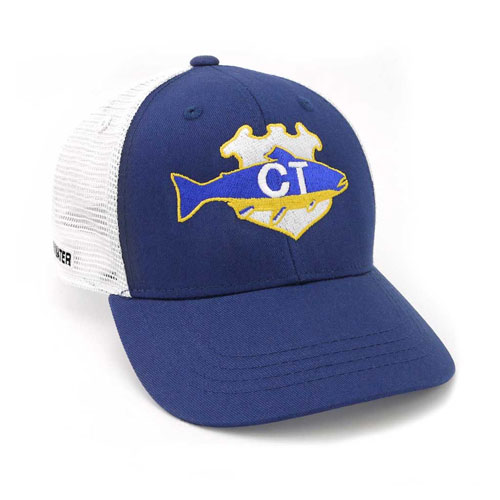
Proceeds from this Connecticut hat sold by Rep Your Water support Trout Unlimited Projects throughout the state.

Look sharp, support conservation

You can look sharp on the stream and support the conservation efforts of Connecticut Trout Unlimited by purchasing merchandise from RepYourWater.

Proceeds from this Connecticut hat sold by Rep Your Water support Trout Unlimited Projects throughout the state.RepYourWater provides creative and unique designs on high-quality apparel and merchandise while making a difference for wildlife habitat around the country. By teaming up with Colorado Trout Unlimited early in its existence, RepYourWater has been able to contribute to the conservation of Colorado fisheries and set in motion what the company is today.

Rep. Your Water has now joined with conservation organizations across the United States, including the Connecticut Council of TU, as 1% partners. Rep Your Water distributes 10% of sales among those 1% partners, based on sales of designs to the Trout Unlimited chapters of Connecticut, Canada, Wyoming, Pennsylvania, the Southeastern Conservation Project and New Mexico; Backcountry Hunters and Anglers Chapters in Utah, Alaska and Montana; the Wild Steelhead Coalition and The Bonefish and Tarpon Trust to provide financial support for the protection of the natural world.

RepYourWater also donates 50% of the proceeds from the Bristol Bay, Native Fish Society and the WILD steelhead hats to the Renewable Resources Fund, Native Fish Society and Wild Steelhead Coalition respectively.  

The message to Connecticut anglers is, the more Connecticut merchandise you buy from Rep Your Water, the more money comes back for local conservation efforts.

For more information on Rep Your Water’s relationship with each non-profit, choose from the drop-down menu on its home page, repyourwater.com.

Planting, fishing on the Mill April 29

The Nutmeg and Mianus chapters of Trout Unlimited will gather to celebrate Arbor Day by planting trees along the Mill River in Fairfield Saturday, April 29, from 9 a.m. to noon.

The project is the latest step in Trout Unlimited’s ongoing rehabilitation of the Mill River, a stream that is home to native brook trout and wild brown trout. Invasive flora has been removed, and native species are being planted along the banks.

Donuts and coffee will be provided.  Please bring a shovel.

Friends, kids and anyone who wants to help may attend.

Register below in “Leave A Reply” by sending us your Name & Email Address and stating April 29 Planting Volunteer in the Comments Box.  You can also register at mianustu.org. 

All Volunteers are asked to register to help with food counts and planning.  After registering watch your emails for any additional information and where to meet.

Feel free to take a fly rod to fish the Mill with us after planting is done. 

We look forward to seeing you there and come back to this site often for more of our fun events.

Tuesday Meeting Features Tony Ritter from the Upper Delaware River Area

Delaware river

On Tuesday, March 15, 2016, Nutmeg TU will hold its monthly meeting at 7PM.  We have a new location at Marissa’s Ristorante, 6540 Main St, Trumbull, CT, just South of where I-25 crosses Route 111.  Tony Ritter is going to share some history on the Upper Delaware River that contributed to the creation of the great tailwater fishery.  And he will tell us some of his tips, and techniques to improve our success for fishing this water.  Along the way we will learn some of the best locations and suggested flies that work well.

Tony has operated a driftboat fishing guide service on the Upper Delaware River and West Branch Delaware for twenty-two years. He specializes in wild trout on one of the best tailwater rivers in the United States located in the Catskill / Pocono Regions of New York and Pennsylvania.  He is licensed by the National Park Service, the NYS DEC and the Pennsylvania FBC.  Between his days on the river teaching new clients casting, and making their day one to remember, Tony is also an elected town councilman for the Town of Tusten in Narrowsburg, NY and has chaired the Upper Delaware Council’s Water Use Resource Management Committee since 2011.

The Upper Delaware River is one of the few rivers in the eastern United States that supports a wild trout fishery with both rainbows and browns. It also has an American Shad run in the spring since there are no dams on this river and is free flowing to the ocean for 270 miles. Besides wild trout and shad, Field and Stream magazine has stated that this river also has one of the five best smallmouth rivers in the United States as well as holding an ample supply of walleye.

The Delaware River is located in a beautiful valley located between the Catskills and Poconos and is two hours northwest of New York City.  Deer, turkey, bald eagles, bear, mink, red tail hawks, beavers, and osprey are not uncommon sights while fishing on a river charter throughout the season which runs from April through November.  There is no industry in the river valley thus the water is clean and well oxygenated, resulting in varied hatches of caddis, mayflies and stoneflies for trout to feed on, as well as many more insects and minnows.

His fly patterns, articles, blog and real time river data can be found at:

www.delawareriverfishing.com

www.catskillmountainflies.com

www.gonefishingguideservice.com


A teacher-naturalist leads a program on the trails of the Connecticut Audubon Society's Fairfield site. More people interested in sharing their knowledge and love of nature are needed.

Audubon Society needs teacher-naturalists

A teacher-naturalist leads a program on the trails of the Connecticut Audubon Society's Fairfield site. More people interested in sharing their knowledge and love of nature are needed.

The Connecticut Audubon Society’s Larsen Sanctuary in Fairfield is hiring teacher-naturalists for its new flagship education program, “Science In Nature.”

The program provides K-12 students outdoor, hands-on, inquiry-based education experiences which are fully integrated into their curriculum. The goal is to help create a deeper, long-term commitment to conservation, as well as contribute to the health and academic success of our state’s children.

The new program explores four habitat types: woodland, freshwater marsh, meadow and pond. During each visit students investigate the habitat types in the context of weather/climate, geology and adaptations.

“Teachers whose students have participated in the program have loved what CAS offers.” said Nelson North, Connecticut Audubon Society’s director of Fairfield operations.

Teacher-naturalists are responsible for teaching outdoor and classroom natural science programs to a variety of audiences, from early learners to adults. Applicants with a minimum of one year teaching experience with proven skills teaching in formal and/or informal settings may apply.

To learn more or for further details about the program, visit the job Opportunities page at ctaudubon.org, or contact Education Director Michelle Eckman by email  or at 203 259-6305, ext. 107.

Meeting in January on Exide cleanup

A meeting will be held in Fairfield during early January to discuss the cleanup of the Exide Battery property, which will affect the Mill River Improvement Project.

Ron Merly told the Nutmeg TU Board of Directors Tuesday, Dec. 6, that the meeting is tentatively scheduled on or around Jan. 10, 2013. Updates will be posted at nutmegtrout.org.

Merly and Russ Ogden have met with Fairfield conservation officials, and Merly called the plans proposed by Exide “very vague.”

Cleanup plans have been discussed for years, but work has not begun. One current proposal, Merly said, would begin work during the annual Herring migration up the Mill River.

Nutmeg TU will follow the process and encourages members to attend the January meeting. Addresses for local, state and federal officials will also be posted at nutmegtrout.org so members can easily contact elected leaders and express their views on the remediation.

Bringing back the salter brook trout

Editor’s Note: At its Dec. 6 meeting, the Nutmeg TU Board of Directors voted to contribute $2,500 of the $5,000 needed to start a fund to help the Sea-Run Brook Trout Coalition bring the fish back to Connecticut.

By Ron Merly

Before brown and rainbow trout were introduced into American waters in the 1860’s and 70’s, the only trout that were naturally found in Connecticut waters were brook trout (actually a char). Brook trout inhabited most of the streams in our state as well as throughout the eastern section of the country.  Sea-run, or salter brook trout were brookies that were caught in the salt estuaries of streams emptying into the saltwater throughout New England and on Long Island. The fish were plentiful and were prized by anglers for their size as well as being delicious table fare. It was common to catch salter brook trout between 6 and 10 pounds and not just one.

As the rivers were dammed and polluted from the Industrial Revolution salter brook trout, like their cousin the Atlantic salmon, were unable to reach their traditional spawning grounds and as a result, populations all but disappeared except for a few little known streams scattered throughout New England.

Ron Merly with a salter brook trout he caught.The Cape has always been a place where these fish were notoriously sought and caught so in the mid 1970’s, restoration work began on remnant populations in Red Brook (See Theodore  Lyman Preserve Red Brook Mass) and afterward, several other streams on Cape Cod. The restoration work proved to be a huge success and continues on streams throughout the Cape. Massachusetts government is now behind the restoration and works with T.U. and the Sea-Run Brook Trout Coalition (SRBTC) on these efforts.

Because of the success of these  restorative projects on the Cape, T.U and the SRBTC are interested in the restoration of salters in other New England  states. Not every stream is a candidate. The criteria for restoration is pretty simple although the research to discover this simple criteria took years of study. In order for a stream to be a candidate for restoration, it must have a wild population of brook trout in its waters. Stocked brook trout do not survive, only wild fish seem to be able to adapt to the salt. The stream must have no barriers so that the fish can freely travel back and forth from the salt to the river making dam removal neccesary. If the stream to be restored is currently being stocked with any trout, the stocking must stop. Brook trout will not climb steep fish ladders so natural passage is preferred.

Finally, there is a general misconception that trout wind up downstream in the salt because they get washed downstream during heavy flows. Trout do not get washed downstream, they know where to hold during heavy flows. The reason that fish move downstream and into a salt estuary is due to food competition. As a stream becomes more and more populated with fish, there becomes competition for the food source. When the dominant fish chase other fish out of their feeding holds, it causes those fish forced out to seek out a place to eat which is how they eventually wind up in the saltwater. Ironically, those fish that were displaced due to food competition are the ones that will grow large because of the rich salt  environment.

T.U. National and the SRBTC have been working with other states to begin restoration in other areas. The first steps toward restoration in Connecticut were recently taken. DEEP biologists, Michael Hopper President of SRBTC, and myself sat down at DEEP headquarters in Old Lyme to establish and begin the restoration of these fish to Connecticut waters. From that meeting, we decided to begin with Anguilla Brook in North Stonington as it meets the general criteria  for restoration. The plan is to begin to electronically monitor the brookies starting in the spring.

The state is unable to fund this project currently so we will need to raise funds through grant applications SRBTC and T.U.  If you have interest in this project please contact Ron Merly.