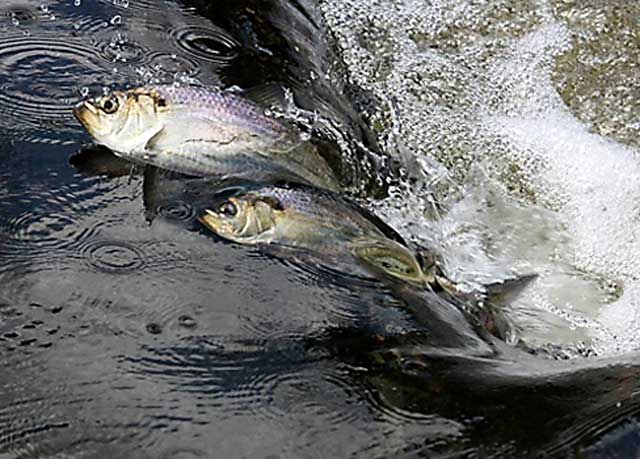
DEEP extends ban on taking alewives, herring
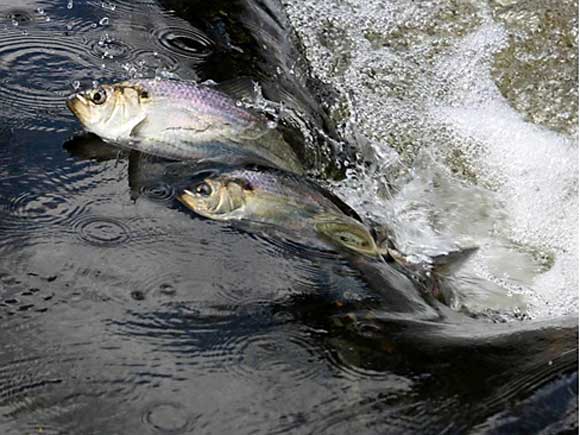
TU-HERRING

The state Department of Energy and Environmental Protection (DEEP) announced Friday, April 5, that the prohibition on the taking of alewives and blueback herring from most inland and marine waters in Connecticut has been extended for another year.

This action was initially taken in April of 2002, and has been extended each successive year because there has been no improvement in population size during the past year. The current action by DEEP Commissioner Daniel C. Esty extends the prohibition through March 31, 2014.

“Despite the conservation efforts taken by this agency and others over the past decade, the runs of river herring in Connecticut are still diminished,” said DEEP Deputy Commissioner Susan Whalen. “The best available data from this past year indicates that the closure of these fisheries must therefore remain in place.”

River herring is a term used collectively to refer to alewife and blueback herring. Both species are anadromous, which means they hatch in freshwater, migrate to the ocean to grow, then return to freshwater to spawn. Historically, millions of river herring returned to Connecticut’s rivers and streams each year. More than 630,000 blueback herring were passed over the Holyoke Dam in Massachusetts on the Connecticut River in 1985. By 2006, only 21 passed the Holyoke Dam, the lowest number in the history of the Holyoke Fishlift. Last year that number was only 39. While river herring are not typically consumed by humans, they are important food to many species of freshwater and marine gamefish, as well as osprey, bald eagle, harbor seals, porpoise, egrets, kingfishers and river otter.

“We still are not certain about the exact cause of the decline in river herring runs, but there is no indication that there is a problem with Connecticut’s rivers and streams,” said William Hyatt, Chief of DEEP’s Bureau of Natural Resources “The decline has been observed all along the east coast and the common factor is the ocean and estuaries. There was a renewed effort during 2012 to address this problem and new steps have been taken. We now wait to see if they help.

“One of our top priorities is to protect populations of wild, native fish,” Hyatt said. “We must work with other states and organizations to protect river herring, which cross jurisdictional boundaries. The prohibition is expected to stay in place until monitoring by the DEEP indicates that the population has recovered to the point where it could safely support some level of harvest.”

During the past year, the New England Fisheries Management Council adopted new rules for commercial fishermen in the ocean to minimize river herring by-catch (unintended harvest) in the Atlantic herring fishery off the coast of northeastern states. A ruling by the National Marine Fisheries Service (NMFS) on whether or not to list both species of river herring under the federal Endangered Species Act was expected in 2012 but has now been delayed until 2013.

Non-migratory alewife populations are established in several lakes and ponds in Connecticut. The DEEP prohibition does not include landlocked alewives from Amos Lake, Ball Pond, Beach Pond, Candlewood Lake, Crystal Lake, Highland Lake, Lake Quassapaug, Lake Quonnipaug, Rogers Lake, Squantz Pond, Uncas Pond, and Lake Waramaug. Alewives in these lakes may still be taken by angling and scoop net as established in state statute and regulation.

The DEEP continues its other efforts to enhance river herring stocks by transplanting adult herring from streams with healthy runs into streams where runs have been eliminated or greatly depleted, removing obsolete dams and building fishways that allow fish to migrate past remaining dams. New fishways at the Hallville Dam on Poquetanuck Brook in Preston, the StanChem Dam on the Mattabesset River in Berlin, and the removal of the Rutan Dam on Anguilla Brook in Stonington as of April 1 will open more than 57 additional miles of habitat for river herring in the state.
Hearing process to begin on Exide cleanup

The Connecticut Department of Energy and Environmental Protection has begun a hearing process on the proposed Mill River cleanup after receiving more than 150 signatures calling for a review.

Only 25 signatures were needed to force a hearing on Exide’s proposal to remove contaminants from the river near the former car battery factory on the Post Road. Click here to read more.

The permitting process for Exide’s plan is now on hold until a remediation plan is finalized.

First Selectman Michael Tetreau and other town officials recently joined state Sen. John McKinney, Rep. Brenda Kupchick, Rep. Tony Hwang and Rep. Kim Fawcett to discuss the cleanup with state officials in Hartford. (Click here to read coverage.)

Updates will be posted as they become available.

Click here for the DEEP page on the project.

Angler’s Guides not printed

The Connecticut Department of Energy and Environmental Protection reports that the full print version 2013 CT Angler’s Guide will be published and distributed in early April.

An electronic version of the 2012 Guide continues to be available online.

There are no new regulations in effect for the 2013 season at this time, according to the DEEP; all regulations found in the 2012 guide remain in effect.

Connecticut begins spring trout stocking

Connecticut DEEP Inland Fisheries staff began the 2013 spring trout stockings this week. Among the areas scheduled to be stocked sometime in the next two weeks are many of the  state’s Trout Management Areas (TMAs).

Early spring stockings are very dependent on weather and site conditions. (Click here for trout stocking maps.)

As of March 1, fishing season is closed on many rivers and streams, and at a number of lakes and ponds.

All 16 of the state’s Trout Management Areas remain open year-round, but all are catch-and-release only during winter and early spring.

Class I Wild Trout Management Areas are also open year-round for catch-and-release fishing.

Broodstock salmon at the Kensington State Fish Hatchery are spawned to provide eggs for the Connecticut River Atlantic salmon Restoration Program. The surplus broodstock DEEP is stocking in 2012 range in size from 2 to 15 pounds each.

State stocks brookstock salmon

The Department of Energy & Environmental Protection (DEEP) has begun its 2012  autumn stockings of broodstock Atlantic salmon.

DEEP’s Inland Fisheries Division  recently released 700 salmon into the Naugatuck River, Mount Tom Pond and Crystal Lake  (Ellington). Another 300 salmon were released into the Shetucket River.

Broodstock salmon at the Kensington State Fish Hatchery are spawned to provide eggs for the Connecticut River Atlantic salmon Restoration Program. The surplus broodstock DEEP is stocking in 2012 range in size from 2 to 15 pounds each.The broodstock Atlantic salmon stocked in Connecticut were raised in state hatcheries to  provide eggs for the Connecticut River Atlantic Salmon Restoration Program and are the progeny of sea-run fish that returned to the Connecticut River.  Beginning in 1992, surplus and spawned fish have  been made available to provide a recreational fishery for Connecticut anglers.

Atlantic salmon are renowned for their size, beauty and fighting ability.

“The broodstock Atlantic salmon program has become quite popular, and catching one of these large leapers provides a  thrilling experience for anglers” said Peter Aarrestad, Director of DEP’s Inland Fisheries Division.

Crystal Lake was stocked Thursday, Sept. 27, with 200 salmon.

On Friday, Sept. 28, Mount Tom Pond was stocked with 100 salmon and the upper Naugatuck River was stocked with 200 salmon.

DEEP planned to stock the Shetucket River with 300 salmon on Monday, Oct. 9, following completion of repairs to the Scotland Dam by FirstLight Power Resources.

This first group of broodstock Atlantic salmon being released range in weight from 2 to 6 pounds  each. Later in October, several hundred additional fish may also be available for stocking. These fish will range from 2 to 15 pounds each. Following spawning later this fall, DEEP expects an additional 800 to 1,000 salmon from the Kensington Hatchery will be available for stocking in November. These fish will range in weight from 4 to 15 pounds each.

Atlantic salmon broodstock stocked in the Shetucket and Naugatuck rivers are typically released into three designated Atlantic Salmon Broodstock Areas: 1) between Scotland Dam (Scotland) and Occum Dam (Norwich) on the Shetucket River; 2) the “Campville Section” of the upper Naugatuck River from Route 118 downstream to the Thomaston Flood Control Dam (Litchfield-
Thomaston); and 3) the “Beacon Falls Section” of the lower Naugatuck from Prospect Street (Naugatuck) downstream to Pines Bridge Road (Route 42 bridge, Beacon Falls).

Anglers are allowed to fish for salmon in the Naugatuck River from the confluence of the East and West Branches (Torrington) downstream to the Housatonic River (Derby). Anglers may also fish for Atlantic salmon in the Housatonic River downstream of Derby Dam.

On the Shetucket River, anglers can fish for salmon downstream from the Scotland Dam (Windham) to the Water Street Bridge
in Norwich (the first bridge upstream of Norwich Harbor). In the Naugatuck, Housatonic and Shetucket Rivers, angling for Atlantic salmon is restricted to catch-and-release only from Oct. 1 through Nov. 30. From Dec. 1, 2012, through March 31, 2013, the daily creel limit for Atlantic salmon will be one.

During the open season in the rivers, the legal method for taking Atlantic salmon is limited to angling using a single fly, or an  artificial lure with a single free swinging hook. No additional weight can be added to the line above the fly or lure.

Also, from October 1st through March 31st, fishing for other species in the designated Atlantic Salmon Broodstock Areas is restricted to the gear legal for Atlantic salmon.

In 2007 DEEP began stocking selected lakes with broodstock Atlantic salmon. This fall, Mount Tom Pond and Crystal Lake are again being stocked. This past spring, 600 smaller (1- to 2-pound fish) were stocked into Long Pond (Ledyard/North Stonington) Crystal Lake, Mount Tom Pond and Nells Rock Reservoir (Shelton). Anglers may also occasionally catch salmon that have held over from
previous stockings of Beach Pond and Mashapaug Lake.

The regulations for broodstock Atlantic salmon released into lakes and ponds are different from the regulations for salmon in the Naugatuck, Housatonic and Shetucket rivers. In each lake, the regulations for methods, seasons and minimum lengths for salmon are the same as for trout in that specific water body but the daily creel limit is one salmon per day. The specific regulations for  salmon fishing in lakes that have been stocked with Atlantic salmon can be found in the 2012 Connecticut Angler’s Guide and below.

The regulations for broodstock Atlantic salmon stocked into lakes and ponds will also be posted at each body of water. Anglers can also contact DEEP’s Inland Fisheries Division (860-424-FISH) for more information.

All other regulations, including those for broodstock salmon in the Naugatuck, Housatonic and Shetucket rivers, can also be found in the 2012 Connecticut Angler’s Guide, found at www.ct.gov/deep/anglersguide. Print versions of the guides are available from many Town Clerks and bait and tackle stores, or by contacting DEEP’s Inland Fisheries Division (860-424-FISH).

Additional fishing and fisheries related information, including the Weekly Fishing Report, can be found on the DEEP web site at: ct.gov/deep/fishing.

Fisheries and Wildlife can now be found directly on Facebook at .facebook.com/CTFishandWildlife. The page features a variety of information on fishing, hunting, and wildlife watching in Connecticut.

This fall, anglers can find updates on DEEP’s broodstock Atlantic salmon stockings and news fall trout stockings in both the Weekly Fishing Reports and on the Fisheries and Wildlife Facebook page.

Lakes
Regulations for Atlantic salmon fishing in Crystal Lake (stocked this fall), Mount Tom Pond (stocked this fall), Long Pond (last stocked-April, 2012) Nells Rock Reservoir (last stocked-April, 2012), Beach Pond (last stocked- 2009) and Mashapaug Lake (last stocked-2009) are as follows:
Crystal Lake
Legal Methods: Angling and Ice Fishing – Fishing with hook and line. May include fishing with bait, flies or lures.
Open Season: Third Saturday in April through last day in March.
Minimum Length: Salmon must be greater than or equal to 16 inches to keep.
Daily creel limit: 1 Atlantic salmon

Mount Tom Pond, Beach Pond*, Long Pond**, Mashapaug Lake*, Nells Rock Reservoir**
Legal Methods: Angling and Ice Fishing – Fishing with hook and line.  May include fishing with bait, flies
or lures.
Open Season: Third Saturday in April through last day in February.
Minimum Length: None
Daily creel limit: 1 Atlantic salmon

*Beach Pond and Mashapaug Lake are not being stocked with broodstock salmon this fall. Both lakes have been stocked previously, most recently in April, 2009.

**Long Pond and Nells Rock Reservoir are not being stocked with broodstock salmon this fall. Both lakes were stocked in April, 2012 with small (1-2 pound) surplus Atlantic salmon.