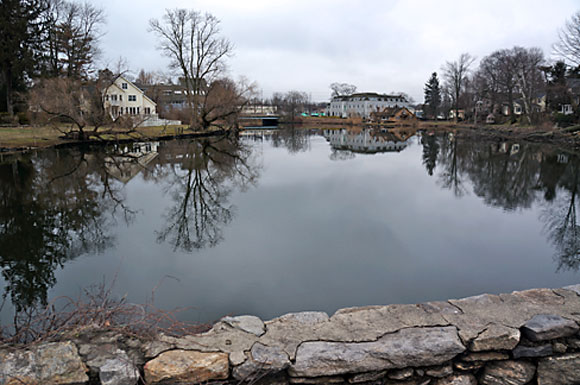
Conjoined trout hatched for the Trout in the Classroom program Meadowside School in Milford.

Rare find in TIC hatch

Conjoined trout hatched for the Trout in the Classroom program Meadowside School in Milford.

The Trout in the Classroom program at Meadowside School in Milford, sponsored by Nutmeg TU, got a surprise when their eggs recently hatched.

Fifth grade teacher Jason Cicero sent this photo of conjoined fry to Gian-Andrea Morresi, TIC coordinator for the Nutmeg Chapter of Trout Unlimited.

“The fish are doing great but when I checked them yesterday I noticed something amazing and wanted to share it with you. We have conjoined twins in our nursery,” Cicero wrote. “I hope the picture comes across so you can see this, it’s amazing! “

“That is different,” DEEP biologist Neal Hagstrom wrote. “Usually you have them belly to belly and often one embryo will overgrow the second before they are this developed.  Sometimes all that is left is an extra fin. Looks like completely separate digestive, neural and circulatory system. Neat shot.”

Trout in the Classroom is TU’s cornerstone environmental education program. Students learn about the importance of clean, cold water as they raise trout from eggs, ultimately releasing them into the wild.

DEEP reports more salmon stocked

DEEP began spawning salmon at the Kensington Hatchery last week and approximately 100 spawned salmon were stocked out earlier this week in the Naugatuck River (upper – 25 fish, lower – 25 fish) and Shetucket River (50 fish).

These fish range in size from 2 to 15 pounds, and average 10 pounds each.

These stockings will bring the number of broodstock Atlantic salmon stocked this fall to approximately 1,800.

CLICK HERE TO READ THE DEEP WEEKLY FISHING REPORT.

Salmon stocked in the Naugatuck

The Connecticut DEEP has stocked Atlantic salmon in the Naugatuck River. (Photo by William Hartley/U.S. Fish & Wildlife Service)

Connecticut’s Department of Energy & Environmental Protection has begun the 2013 autumn stockings of broodstock Atlantic salmon.  DEEP’s Inland Fisheries Division recently released 300 salmon into the Naugatuck River and Mount Tom Pond.  Later this week, DEEP will release 300 salmon into the Shetucket River and Crystal Lake.

“Atlantic salmon are renowned for their size, beauty and fighting ability,” said Peter Aarrestad, Director of DEEP’s Inland Fisheries Division.  “The Atlantic salmon recreational fishery has become quite popular, and catching one of these large leapers provides a thrilling experience for anglers.”

The Atlantic salmon being stocked in Connecticut were raised in the Kensington State Fish Hatchery and are the progeny of sea-run fish that returned to the Connecticut River.  Salmon at this hatchery were raised to provide eggs for the Connecticut River Atlantic Salmon Restoration Program that began in 1967.  Since 1992, surplus and spawned fish from this program were made available to provide a recreational fishery for Connecticut anglers.

Click here to read more in The Valley Gazette.


Streamflow changes proposed in some rivers

DEEP has taken the first step toward implementation of streamflow protections. This step is the classification of streams within a given watershed as Class 1 to Class 4 (high quality to terrible quality). The classification determines the level of flow protection that will be accorded under the regulation.

The Connecticut Council of TU said DEEP has done an outstanding job in creating maps that present most of the information essential to understanding the classifications and reasons for the classifications. It has started with the eastern portion of the state.

“It is very important for friends of rivers all across Connecticut to review and comment on these maps,” according to a notice from the council. “You may want to advocate for certain adjustments to the rationale or process of classification.”

The DEEP has prepared maps of proposed stream flow classifications for the Southeast Coastal, Pawcatuck and Thames Major River Basins, available online. The maps include river and stream segments in Andover, Ashford, Bolton, Bozrah, Brooklyn, Canterbury, Chaplin, Colchester, Columbia, Coventry, East Lyme, Eastford, Franklin, Griswold, Groton, Hampton, Hebron, Killingly, Lebanon, Ledyard, Lisbon, Mansfield, Montville, New London, North Stonington, Norwich, Old Lyme, Plainfield, Pomfret, Preston, Putnam, Salem, Scotland, Sprague, Stafford, Sterling, Stonington, Thompson, Tolland, Union, Vernon, Voluntown, Waterford, Willington, Windham, and Woodstock.

Public information sessions will be held at:

Northeast CT Council of Governments, 125 Putnam Pike, Dayville, on Tuesday, Oct. 15, in two sessions: 2-4 p.m. and 6-8 p.m.

Southeastern CT Council of Governments, 5 Connecticut Ave., Norwich, on Wednesday, Oct. 16, in two sessions: 2-4 p.m. and 6-8 p.m.

A short presentation on how the stream flow classification maps were developed will be given, copies of the maps will be available for inspection, and Department staff will be on hand to answer questions at these information sessions.

The proposed stream flow classification of a stream or river segment is based on ecological conditions and human use characteristics, and determines flow management goals and applicable flow standards for that segment. Proposed stream flow classifications were developed using known information on factors indicative of the degree of human alteration of natural stream flow, environmental flow needs and existing and future needs for public water supply.

The public may submit additional information or comments for the Commissioner’s consideration on the proposed classification of a specific river or stream system pertaining to, but not limited to: (i) the factors for consideration in the regulations; (ii) the impact of the proposed classification on any prior investment made to develop a permitted or registered diversion and the alternatives, if any, to the diversion including cost factors and feasibility of such alternatives; (iii) the relationship of an existing or proposed diversion to economic development or jobs; and (iv) the practicality of, and potential for, achieving ecological benefit from restoring streamflow to the specific river or stream system. Written comments may be submitted by email to deep.streamflowclass@ct.gov, or may be mailed to Robert Hust, Department of Energy & Environmental Protection, Bureau of Water Protection and Land Reuse, 79 Elm Street, Hartford, Connecticut, 06106-5127. The Department is accepting additional information or written comments on the proposed Streamflow Classifications until Tuesday, Dec. 31, 2013.

Additional information on the Stream Flow Standards and Classifications is available on the Department’s website at: www.ct.gov/deep/streamflow . Anyone requiring more information may contact the Department by email at deep.streamflowclass@ct.gov or by phone at 860-424-3020.

The Connecticut Department of Energy and Environmental Protection is an Affirmative Action and Equal Opportunity Employer that is committed to complying with the Americans with Disabilities Act. To request an accommodation call 860-424-3194 or email deep.accommodations@ct.gov.

The Rivers Alliance will also help with questions. Information can be found at www.riversalliance.org.

Beneath the surface of the lower Mill River lies lead and other waste from the former Exide battery plant. The company has announced a plan to clean the river, but some neighbors and conservationists fear what the work could stir up. (Fairfield Sun/Shawn O'Sullivan)

Fairfield gives green light to Exide cleanup

Beneath the surface of the lower Mill River lies lead and other waste from the former Exide battery plant. The company has announced a plan to clean the river, but some neighbors and conservationists fear what the work could stir up. (Fairfield Sun/Shawn O'Sullivan)

Plans for cleanup of the Mill River are once again moving forward. In a joint session on Aug 1, The Harbor Management, Shellfish and Conservation commissions all voted to end Fairfield’s intervention in planning the removal of contaminants left in the Mill River by the former Exide battery plant.

In January of this year, after an information session held by DEEP and Exide, both Fairfield’s Shellfish Commission and local advocacy group Fairfielders Protecting Land and Neighborhoods (FairPLAN) requested a public hearing on one of the permits required for Exide’s remediation activities. This delayed DEEP in approving Exide’s plan, and led to a new approach.

Click here for the Fairfield Sun story.

Sample aquatic life in the Saugatuck

The Nature Conservancy is hosting its 10th annual macroinvertebrate sampling and training program to monitor the health of the Saugatuck River system, and you are invited to participate in one or both events.

The first part of the morning will be an indoor training on macroinvertebrates and the sampling method. Volunteers will then break into teams and drive out to a river site to take their samples. Staff will move from site to site to offer assistance in the identification of the different organisms.

The first Macroinvertebrate Training and Sampling Event begins at 9 a.m. Saturday, Oct. 5, at the Weston Public Library, 56 Norfield Road, Weston, continuing at sampling sites along the Saugatuck River.

The second event will begin at 9 a.m. Sunday, Oct. 6, in the Community Room at the Redding Community, 37 Lonetown Road), Redding (behind Redding Elementary School, then move to sampling sites along the Saugatuck River

All volunteers work in teams.

Work is usually completed by 9 a.m.

Registration is required by Tuesday, Oct. 1. To register or obtain more information, contact Cynthia Fowx, Saugatuck Forest Lands Office Administrator & Volunteer Coordinator, at The Nature Conservancy, Devil’s Den Preserve, P.O. Box 1162, 33 Pent Road, Weston, CT 06883. She can also be reached at theden@tnc.org, 203-226-4991 Ext. 116 (Phone) or 203-226-4807 (Fax).

All participants are required to register in advance.

New volunteers must submit a liability waiver and information short forms as part of the registratio; contact Fowx if you need these forms, which are also available at http://www.nature.org/ourinitiatives/regions/northamerica/unitedstates/connecticut/volunteer/index.htm.

The sampling program is part of the Connecticut DEEP’s Rapid Bioassessment in Wadeable Streams & Rivers by Volunteer Monitors (RBV) Program, which provides a way of determining the health of a river system by identifying organisms found in the stream bottom. Data is submitted to CT DEEP for use in water quality assessments. Information can be found at http://www.ct.gov/dep/cwp/view.asp?a=2719&q=325606&depNav_GID=1654 or in The Nature Conservancy’s flyer at http://www.nature.org/ourinitiatives/regions/northamerica/unitedstates/connecticut/volunteer/ct-river-sampling-event-2013.pdf.

Freshwater benthic macroinvertebrates are animals without backbones that are visible to the naked eye and dwell in the bottom of streams. The group includes crayfish, mollusks such as clams and snails, aquatic worms and immature forms of aquatic insects such as stonefly, dragonfly and mayfly nymphs. These organisms have varying tolerances for environmental conditions and therefore are excellent indicators of water quality.

At least two members of each sampling team should go into the water.  The water can be quite chilly, but doesn’t require that you go in above a wadeable height (somewhere between the tops of rain boots and your waist, usually).

Those who volunteer should take a bag lunch and a change of clothes. Dress for the weather and to go in the water (waders or water shoes and clothes you don’t mind getting wet).  Sunscreen and bug spray are also recommended. Some other things you might want to take include a ground cloth or cushion to sit on the ground and sort your samples, a towel in case you get wet and plastic zip-top bag(s) for phone or other items.

Beneath the surface of the lower Mill River lies lead and other waste from the former Exide battery plant. The company has announced a plan to clean the river, but some neighbors and conservationists fear what the work could stir up. (Fairfield Sun/Shawn O'Sullivan)

Meetings on Exide plan come to Fairfield

Local discussions of a plan to remediate industrial wastes left behind by the former Exide battery plant next to the Mill River are scheduled to begin this week.

The draft plan calls for the lower Mill River to be dredged. The full plan can be downloaded from the Fairfield Conservation Department website, at http://www.fairfieldct.org/conscomiss.htm.

The Harbor Commission will review a draft Remediation Action Plan (SedRAP) Monday, July 8, at 4:30 p.m. in the second floor conference room at Sullivan Independence Hall. Public comment will be allowed.

The Shellfish Commission will perform its review Wednesday, July 10, at 7:30 p.m., also in the second floor conference room at Sullivan Independence Hall.

The Board of Selectmen will also discuss the plan at a date to be announced, and permits will be required for all work.

A hearing with the Department of Energy and Environmental Protection is also pending.

If the Town of Fairfield, the DEEP, Exide and Fair PLAN, a local environmental group, can come to agreement on the plan, the DEEP hearing will be closed and work will begin.

But if those parties cannot agree on how to proceed, the hearing will continue and a hearing officer will determine the course of action based on evidence presented.

Hearings were held in March. Details on the entire process can be found at http://www.ct.gov/deep/cwp/view.asp?a=2719&q=517076&deepNav_GID=1654.

Nutmeg TU members commented during earlier hearings on the proposal.

Fish and fishing would be affected during implementation of the plan.

Part of the deliberations center on increased sediment suspension and a greater disruption to flora and fauna if more material is removed.

“A significant socio-economic issue to consider in assessing overall benefits is the anticipated impact to recreational fishing and shellfish harvesting during and after remedial activities,” the draft reads. “The analysis concludes that risk to humans through consumption of fish/shellfish or ingestion of lead-contaminated sediment is substantially elevated in Area II, and elevated in  Area I, with no substantial risks in Areas III, IV & V.  The present risks  must be weighed against the disturbance of these activities both during  and after remediation.  During remedial activities fishing/shellfish harvesting will not be physically possible in the immediate area of work and the destruction of substrates (i.e. submerged aquatic vegetation (SAV) and the benthic community) on which fish and shellfish are dependent may temporarily decrease fish and shellfish populations.  According to Exponent, recovery of SAV and the benthic community from dredging activities is expected to take 1-3 years.  These factors must be weighed against the overall remedial goal, which is complete removal of human risk from consuming lead-contaminated fish or shellfish.”

The long-term gains from removing lead, according to background in the plan, outweighs short-term disruptions.

Because a installation of a curtain that won’t restrict migration, dredging will not be allowed during the anadromous fish migration period in the Southport Harbor area, bounded by Harbor Road and a project limit line 225 feet south of Harbor Road.

Dredged material will be dried at the former Exide facility, 2190 Post Road, currently a vacant lot next to the Mill River, surrounded by a chain-link fence. That site will also be used for access and egress, staging of equipment and operations headquarters. The east bank of the Mill River, where work stopped during the 2005-09 Upland RAP, will need to be remediated and stabilized to allow the use of this area.

In preparation for the full project, the contractor would need to strip topsoil and install a layer of crushed stone. “The contractor may propose to install asphalt paving in lieu of crushed stone but will need to account for, through the use of engineered controls, any stormwater run-off that may results from this paving,” according to the draft plan.

Dredged material would be placed in Geotubes, “large bags made from a high tensile strength woven polypropylene fabric “geotextile” panels sewn to form long tubes for containment of pumped slurry,” according to the draft plan. The sediment will dry in those.

“In addition,” the plan continues, “two soil/sediment stockpile cells will be constructed using concrete barriers (construction block). Each concrete cell will have a capacity of no more than 250 cubic yards, surrounded by high-density sheeting to contain sediment.

The contractor will be required to “dredge, properly handle, transport and dispos of contaminated material (hazardous and non-hazardous), including characterizing the material, manifesting the loads, and obtaining approval from EPA-approved RCRA landfills and RCRA Out-of-State lined landfills,” according to the plan.

Fairfield’s sewer system cannot handle the volume of water discharged as the slurry is “dewatered,” according to the SedRAP, so filtrate will need to be discharged back into the Mill River.

Exide has applied to the DEEP to permit the discharge under a federal EPA program.

Bacteria sampling, if deemed necessary by DEEP and the Connecticut Department of Agriculture, will be conducted and evaluated by the agencies.

Exide has proposed construction of a “turbidity curtain,” or barrier, to contain sediment, with a corridor 15 feet wide and 2 feet deep to allow migration of fish from April through July.
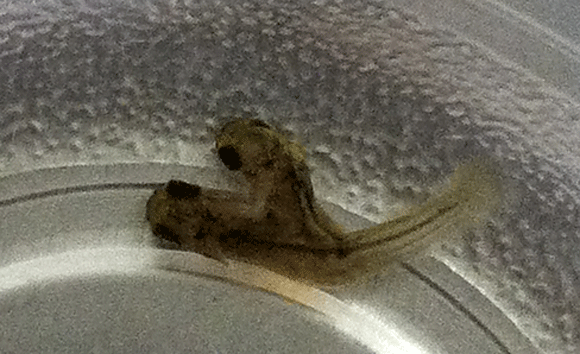
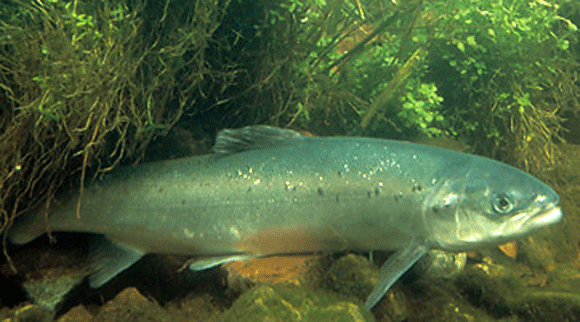
Chart identifies tagged fish in the Housy

Mike Humphreys, a fishery biologist for the state DEEP, provided the Housatonic Fly  Fisherman’s with the attached chart at a recent meeting.

Humphreys spoke of this chart at the HFFA’s April membership meeting. This will help anglers identify the types of stocked fish they catch and release up on the Housy.

Mike is always looking for angler feedback, which helps to assess holdover  rates, by species and length stocked. This helps the CTDEEP determine the best types, sizes and periods to stock trout, Dan Keney of the HFFA said.

The chart covers data from 2011 to the pending stocking this fall.

The identification tag mark  feedback also helps measure trout holdover rates and the impact of the HFFA’s annual  thermal refuge work and other club conservation efforts.