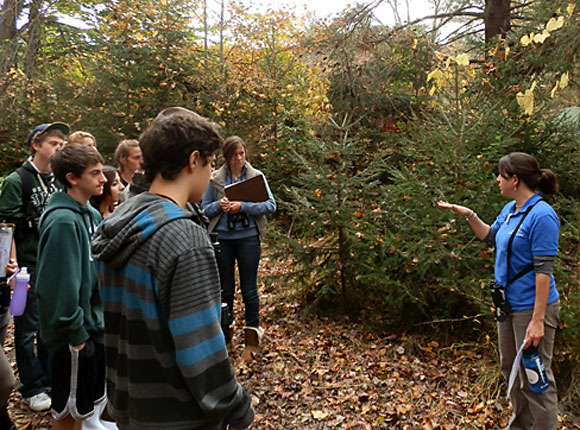
A teacher-naturalist leads a program on the trails of the Connecticut Audubon Society's Fairfield site. More people interested in sharing their knowledge and love of nature are needed.

Audubon Society needs teacher-naturalists

A teacher-naturalist leads a program on the trails of the Connecticut Audubon Society's Fairfield site. More people interested in sharing their knowledge and love of nature are needed.

The Connecticut Audubon Society’s Larsen Sanctuary in Fairfield is hiring teacher-naturalists for its new flagship education program, “Science In Nature.”

The program provides K-12 students outdoor, hands-on, inquiry-based education experiences which are fully integrated into their curriculum. The goal is to help create a deeper, long-term commitment to conservation, as well as contribute to the health and academic success of our state’s children.

The new program explores four habitat types: woodland, freshwater marsh, meadow and pond. During each visit students investigate the habitat types in the context of weather/climate, geology and adaptations.

“Teachers whose students have participated in the program have loved what CAS offers.” said Nelson North, Connecticut Audubon Society’s director of Fairfield operations.

Teacher-naturalists are responsible for teaching outdoor and classroom natural science programs to a variety of audiences, from early learners to adults. Applicants with a minimum of one year teaching experience with proven skills teaching in formal and/or informal settings may apply.

To learn more or for further details about the program, visit the job Opportunities page at ctaudubon.org, or contact Education Director Michelle Eckman by email  or at 203 259-6305, ext. 107.

Meeting in January on Exide cleanup

A meeting will be held in Fairfield during early January to discuss the cleanup of the Exide Battery property, which will affect the Mill River Improvement Project.

Ron Merly told the Nutmeg TU Board of Directors Tuesday, Dec. 6, that the meeting is tentatively scheduled on or around Jan. 10, 2013. Updates will be posted at nutmegtrout.org.

Merly and Russ Ogden have met with Fairfield conservation officials, and Merly called the plans proposed by Exide “very vague.”

Cleanup plans have been discussed for years, but work has not begun. One current proposal, Merly said, would begin work during the annual Herring migration up the Mill River.

Nutmeg TU will follow the process and encourages members to attend the January meeting. Addresses for local, state and federal officials will also be posted at nutmegtrout.org so members can easily contact elected leaders and express their views on the remediation.

Bringing back the salter brook trout

Editor’s Note: At its Dec. 6 meeting, the Nutmeg TU Board of Directors voted to contribute $2,500 of the $5,000 needed to start a fund to help the Sea-Run Brook Trout Coalition bring the fish back to Connecticut.

By Ron Merly

Before brown and rainbow trout were introduced into American waters in the 1860’s and 70’s, the only trout that were naturally found in Connecticut waters were brook trout (actually a char). Brook trout inhabited most of the streams in our state as well as throughout the eastern section of the country.  Sea-run, or salter brook trout were brookies that were caught in the salt estuaries of streams emptying into the saltwater throughout New England and on Long Island. The fish were plentiful and were prized by anglers for their size as well as being delicious table fare. It was common to catch salter brook trout between 6 and 10 pounds and not just one.

As the rivers were dammed and polluted from the Industrial Revolution salter brook trout, like their cousin the Atlantic salmon, were unable to reach their traditional spawning grounds and as a result, populations all but disappeared except for a few little known streams scattered throughout New England.

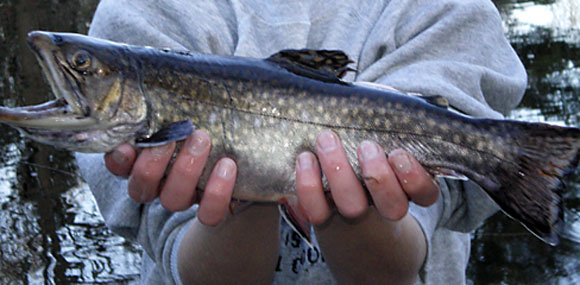
Ron Merly with a salter brook trout he caught.The Cape has always been a place where these fish were notoriously sought and caught so in the mid 1970’s, restoration work began on remnant populations in Red Brook (See Theodore  Lyman Preserve Red Brook Mass) and afterward, several other streams on Cape Cod. The restoration work proved to be a huge success and continues on streams throughout the Cape. Massachusetts government is now behind the restoration and works with T.U. and the Sea-Run Brook Trout Coalition (SRBTC) on these efforts.

Because of the success of these  restorative projects on the Cape, T.U and the SRBTC are interested in the restoration of salters in other New England  states. Not every stream is a candidate. The criteria for restoration is pretty simple although the research to discover this simple criteria took years of study. In order for a stream to be a candidate for restoration, it must have a wild population of brook trout in its waters. Stocked brook trout do not survive, only wild fish seem to be able to adapt to the salt. The stream must have no barriers so that the fish can freely travel back and forth from the salt to the river making dam removal neccesary. If the stream to be restored is currently being stocked with any trout, the stocking must stop. Brook trout will not climb steep fish ladders so natural passage is preferred.

Finally, there is a general misconception that trout wind up downstream in the salt because they get washed downstream during heavy flows. Trout do not get washed downstream, they know where to hold during heavy flows. The reason that fish move downstream and into a salt estuary is due to food competition. As a stream becomes more and more populated with fish, there becomes competition for the food source. When the dominant fish chase other fish out of their feeding holds, it causes those fish forced out to seek out a place to eat which is how they eventually wind up in the saltwater. Ironically, those fish that were displaced due to food competition are the ones that will grow large because of the rich salt  environment.

T.U. National and the SRBTC have been working with other states to begin restoration in other areas. The first steps toward restoration in Connecticut were recently taken. DEEP biologists, Michael Hopper President of SRBTC, and myself sat down at DEEP headquarters in Old Lyme to establish and begin the restoration of these fish to Connecticut waters. From that meeting, we decided to begin with Anguilla Brook in North Stonington as it meets the general criteria  for restoration. The plan is to begin to electronically monitor the brookies starting in the spring.

The state is unable to fund this project currently so we will need to raise funds through grant applications SRBTC and T.U.  If you have interest in this project please contact Ron Merly.

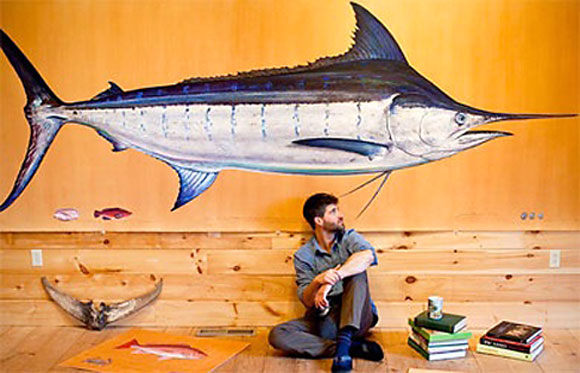
James Prosek will discuss his newest work, Ocean Fishes, at Nutmeg TU's annual Holiday Party Tuesday, Dec. 18, at the Fairchild Wheeler Golf Course. (Photo from troutsite.com)

James Prosek to speak at holiday party Dec. 18

James Prosek will discuss his newest work, Ocean Fishes, at Nutmeg TU's annual Holiday Party Tuesday, Dec. 18, at the Fairchild Wheeler Golf Course. (Photo from troutsite.com)

James Prosek will discuss his latest book, “Ocean Fishes” when Nutmeg TU Chapter 217 holds it annual holiday party Tuesday, Dec. 18, at 7 p.m.

The party will be held at a new location, Vazzy’s 19th Hole at the Fairchild Wheeler Golf Course, 2390 Easton Tpke., Fairfield. Directions can be found at nutmegtu.org. Pizza and sandwich-type fare will be served. There will be a cash bar.

Prosek’s appearance with his local TU chapter comes on the heels of his speaking at the Explorers Club in New York City Nov. 19. On Dec. 5, James Prosek was awarded the Gold Medal for Distinction in Natural History Art from the Academy of Natural Sciences in Philadelphia. Among previous recipients are Roger Tory Peterson, Ansel Adams, Peter Matthiessen and John McPhee.

The exhibit Ocean Fishes is on display at the Academy of Natural Sciences in Philadelphia through Jan. 21.

Ocean Fishes is James Prosek’s personal tribute to marine beauty unlike any published before, based on travel, intense observation, work with scientists, and stories of those who know the fish most intimately: fishermen (both recreational and commercial).

It is also the author’s quiet conservation statement, according to his website, troutsite.com. In showing the beauty and monumentality of these fish, Prosek is urging us to preserve what we have before it is lost.

“These paintings give the reader a privileged view of a fish fresh from the ocean when its changing colors first glint in the sun — a view ordinarily glimpsed only by the fishermen on the boat,” according to the website.

This book is not intended as a scientific catalogue of ocean fishes. each painting reflects Prosek’s individual experience with a single fish. The artist traveled the Atlantic from Nova Scotia to the Cape Verde Islands to see each species firsthand as it came out of the water before it lost its living colors. The original paintings are all life-size portraits (from a 14-inch porgy to a 12-foot, 8-inch blue marlin) and will be exhibited at several venues from Monaco to Philadelphia. Details from these original works are reproduced at full-size in the book to give a sense of scale.

Artist, writer, activist, and Yale graduate James Prosek made his authorial debut at 19 years of age with Trout: an Illustrated History (Alfred A. Knopf, 1996), which featured 70 of his watercolor paintings of the trout of North America. Prosek has shown his paintings with the Gerald Peters Gallery, New York and Santa Fe; Meredith Long Gallery, Houston; as well as with Wajahat/Ingrao, New York, the d.u.m.b.o. arts center, Brooklyn, Reynolds Gallery, Richmond, VA and the Aldrich Contemporary Art Museum in Ridgefield.

Prosek has written for The New York Times and National Geographic Magazine and won a Peabody Award in 2003 for his documentary about traveling through England in the footsteps of Izaak Walton, the 17th-century author of The Compleat Angler. He co-founded a conservation initiative called World Trout in 2004 with Yvon Chouinard, the owner of Patagonia clothing company, which raises money for coldwater habitat conservation through the sale of T-shirts featuring trout paintings. His book Eels: An Exploration, from New Zealand to the Sargasso, of the World’s Most Amazing and Mysterious Fish, will be published by HarperCollins in September 2010. He is working on a book of paintings of Atlantic fishes for Rizzoli and a project about naming nature.

Prosek is a curatorial affiliate of the Peabody Museum of Natural History at Yale, and a member of the board of the Yale Institute for Biospheric Studies.

Major prizes available in Dec. 18 holiday raffle

Nutmeg TU will draw winners of its annual raffle during the holiday party Tuesday, Dec. 18.

The meeting, starting at 7 p.m. at Vazzy’s 19th Hole at the Fairchild Wheeler Golf Course, 2390 Easton Tpke., Fairfield, will feature guest speaker James Prosek.

Raffle tickets are available from Nutmeg TU members.

Prizes include:

• First prize: A Winston Boron IIIx 4-piece, 9-foot, 5-wt fly rod

• Second Prize: A $250 Orvis gift certificate

• Third prize: Choice of an Orvis Battenkill mid-arbor or Access reel

• Fourth Prize: A Cabelas deluxe gear bag

• Mystery prize: Always something special. You must be present at the holiday meeting to win this one.

Fly tying nights at Fred Lord’s

If you already have tied a few flies before, Fred Lord graciously hosts fly tying evenings at his home in Monroe from 7-9 pm every other Wednesday.

Focus is on learning new techniques and fly tying materials.

A $1 contribution per evening is suggested to help defray Fred’s costs of materials.

Email fredelord@att.net  or call him (afternoons) at 203-261-8282  for more information.

Tom Johnson helped restore native habitat to the Mill River Oct. 6.

New life along the Mill River

Great day down on the Mill River Saturday, Oct. 6. We started at 8:30 a.m., finished up around 12:30 p.m. and had perfect weather for planting.

Tom Johnson helped restore native habitat to the Mill River Oct. 6. Roughly 15 folks attended, evenly split between volunteers from TU and ALT. From TU, we had myself, Ron Merly, Bob Campbell, Alan Boyd, Rich Rosen, David Winkelmann, Nick Campofranco and John Kovach. From ALT we had Bob Fatherly, Tom Johnson, Wendy Macbeth, Donna Naser, and Stuart Richardson. (My apologies if I neglected to mention anyone.)

Dave Anderson from New England Wetland Plants was also there. He supplied all of the plants and volunteered his time to help with the planting.

We started the day by splitting into two groups, one for invasive removal and one for planting.  As the day progressed it became all hands on deck for planting. We planted 450 trees, shrubs and plants!

Notable species include (common names): Tulip poplar, sycamore, witch hazel, hornbeam, red-osier dogwood, gray dogwood, silky dogwood, arrowwood viburnum, swamp rose, buttonbush and several species of willow.

Additionally, we were able to preserve several pre-existing American beech, sassafras, black birch and spice bush saplings that would have likely been overcome by all of the invasives.

The area looks great, albeit a little barren, but I fully expect it will start to fill out come spring as many of the species begin to take root and expand their profile. Visitors to the area will note a large amount of deer fencing erected around the perimeter of the main

planting area. This is designed to limit both human and wildlife traffic and hopefully give the plantings an optimal chance for survival.

Going forward we will need to monitor the progress of the plantings and continue to work on the invasive removal. One obvious thing was that the wild grape, multi-flora rose and Japanese barberry continue to remain heavily rooted in the area and several plants had bounced back from our May removal efforts. We will probably need to get a small group out there again in the spring to keep it clean.

Feedback on the project and the results are appreciated. I hope this is the first of many steps in our Mill River Improvement Project.

Many thanks to all those who participated and I look forward to working with everyone again on the next event.