Bob Wesolowski

Learn to fish the Croton Watershed

Bob Wesolowski

Bob Wesolowski will discuss “Fishing the Croton Watershed at the next regular meeting of Trout Unlimited Nutmeg Chapter 217 Tuesday, May  15, 2012, at 7:30 p.m. at the Fayerweather Yacht Club, 51 Brewster St. in the Black Rock section of Bridgeport

Compared with some members of his chapter, Bob is a relative newcomer to fly fishing. He only started 15 years ago. For the past 5 years he has been president of this 600+ member chapter. He’s now ending his third and final term.

As chapter president, Bob has seen Croton Watershed go through significant changes. The age of a typical board member has dropped from the low 70’s to the mid-50’s. Trout in the Classroom is now the largest program in New York with 24 schools. The Chapter’s fly fishing and fly tying schools have been updated. Every year 15-20 students graduate from the fly fishing school and 5-10 students graduate from the tying school. Bob runs the fly tying school.

Bob is often asked to do presentations. Over the past few years he has done the Croton presentation for the Candlewood Valley, Mid-Hudson and New York City chapters and for the new Orvis, Ridge Hill store. He is also a frequent presenter at the local fly shop, The Bedford Sportsman in Bedford Hills, N.Y.

Yates prepares anglers for opening day

Guide, author and Trout Unlimited leader Jeff Yates will lead a talk on “Fly Fishing on Opening Day” at the next regular meeting of the Nutmeg Chapter of Trout Unlimited.

The meeting will be held at the Fayerweather Yacht Club, 51 Brewster St. in the Black Rock section of Bridgeport, at 7:30 p.m. Tuesday, April 17,2012,  just four days before the start of trout season in Connecticut.

Yates has been fishing the waters of Fairfield County for 20 years. A fourth generation Wilton resident, his intimate knowledge of the Norwalk, Mianus, Saugatuck and Mill rivers in lower Fairfield County provide productive outings on local waters. He has also discovered the secret streams throughout the region for targeting native brook trout, and can guide clients to a successful day of fishing for these native New England gems.

His book, “Fly Fishing Fairfield County: Secrets of Suburban Streams,” contains 200 pages of photographs, detailed maps complete with local roads and parking directions, and descriptions of every trout stream in southwestern Connecticut.

Yates also leads trips to the Farmington River.

Summers spent fishing the streams of Vermont, hundreds of hours on the waters of Long Island Sound and years of angling for Atlantic Salmon in the Naugatuck River mean clients have a range of options to choose from.

A master guide and fly tyer, Yates said his goal is for clients to learn the access points and techniques that will make them successful anglers on their own future outings.

Guiding sessions are catch-and-release only and include lessons on insect entomology, stream flows and conditions, reading the water, improving casting skills and conservation and history.

President of the Mianus Chapter of Trout Unlimited, board member of Friends of Mianus River Park, life member of Trout Unlimited and the Housatonic Fly Fishers Association, Jeff is also a member of the American Museum of Fly Fishing and the Catskills Fly Fishing Center and Museum. When he’s not guiding or fishing, Yates is leading river restoration projects or planning fishing and conservation events and clinics.

Information can be found at http://www.flyfishingct.com, or on Twitter and Facebook.

Antoine Bissieux, “The French Flyfisherman”

‘The French Flyfisherman’

Antoine Bissieux, “The French Flyfisherman”

Antoine Bissieux, “The French Flyfisherman” will discuss “Fish on the Fly” at the March 20, 2012, meeting of Nutmeg TU Chapter 217.

A 2012 Orvis-endorsed guide, Bissieux leads fly fishing trips on the Farmington River in Connecticut, the Battenkill River in Vermont, and other places where you can cast at a fish.

After teaching thousands of beginner anglers and guiding at the Orvis fly fishing flagship school in Manchester, Vt.,  he now focuses on the Farmington, offering guided trips, classes, instruction all catered to each fisherman’s expectations. All levels and abilities are welcome.

More information can be found a bissieux.com.

Regular meetings are held the third Tuesday of each month (in season) at 7:30 p.m. at the Fayerweather Yacht Club in the historic Black Rock section of Bridgeport., 51 Brewster St. Free pizza precedes meetings.

Broodstock salmon at the Kensington State Fish Hatchery are spawned to provide eggs for the Connecticut River Atlantic salmon Restoration Program. The surplus broodstock DEEP is stocking in 2012 range in size from 2 to 15 pounds each.

State stocks brookstock salmon

The Department of Energy & Environmental Protection (DEEP) has begun its 2012  autumn stockings of broodstock Atlantic salmon.

DEEP’s Inland Fisheries Division  recently released 700 salmon into the Naugatuck River, Mount Tom Pond and Crystal Lake  (Ellington). Another 300 salmon were released into the Shetucket River.
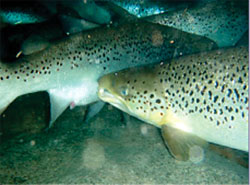
Broodstock salmon at the Kensington State Fish Hatchery are spawned to provide eggs for the Connecticut River Atlantic salmon Restoration Program. The surplus broodstock DEEP is stocking in 2012 range in size from 2 to 15 pounds each.The broodstock Atlantic salmon stocked in Connecticut were raised in state hatcheries to  provide eggs for the Connecticut River Atlantic Salmon Restoration Program and are the progeny of sea-run fish that returned to the Connecticut River.  Beginning in 1992, surplus and spawned fish have  been made available to provide a recreational fishery for Connecticut anglers.

Atlantic salmon are renowned for their size, beauty and fighting ability.

“The broodstock Atlantic salmon program has become quite popular, and catching one of these large leapers provides a  thrilling experience for anglers” said Peter Aarrestad, Director of DEP’s Inland Fisheries Division.

Crystal Lake was stocked Thursday, Sept. 27, with 200 salmon.

On Friday, Sept. 28, Mount Tom Pond was stocked with 100 salmon and the upper Naugatuck River was stocked with 200 salmon.

DEEP planned to stock the Shetucket River with 300 salmon on Monday, Oct. 9, following completion of repairs to the Scotland Dam by FirstLight Power Resources.

This first group of broodstock Atlantic salmon being released range in weight from 2 to 6 pounds  each. Later in October, several hundred additional fish may also be available for stocking. These fish will range from 2 to 15 pounds each. Following spawning later this fall, DEEP expects an additional 800 to 1,000 salmon from the Kensington Hatchery will be available for stocking in November. These fish will range in weight from 4 to 15 pounds each.

Atlantic salmon broodstock stocked in the Shetucket and Naugatuck rivers are typically released into three designated Atlantic Salmon Broodstock Areas: 1) between Scotland Dam (Scotland) and Occum Dam (Norwich) on the Shetucket River; 2) the “Campville Section” of the upper Naugatuck River from Route 118 downstream to the Thomaston Flood Control Dam (Litchfield-
Thomaston); and 3) the “Beacon Falls Section” of the lower Naugatuck from Prospect Street (Naugatuck) downstream to Pines Bridge Road (Route 42 bridge, Beacon Falls).

Anglers are allowed to fish for salmon in the Naugatuck River from the confluence of the East and West Branches (Torrington) downstream to the Housatonic River (Derby). Anglers may also fish for Atlantic salmon in the Housatonic River downstream of Derby Dam.

On the Shetucket River, anglers can fish for salmon downstream from the Scotland Dam (Windham) to the Water Street Bridge
in Norwich (the first bridge upstream of Norwich Harbor). In the Naugatuck, Housatonic and Shetucket Rivers, angling for Atlantic salmon is restricted to catch-and-release only from Oct. 1 through Nov. 30. From Dec. 1, 2012, through March 31, 2013, the daily creel limit for Atlantic salmon will be one.

During the open season in the rivers, the legal method for taking Atlantic salmon is limited to angling using a single fly, or an  artificial lure with a single free swinging hook. No additional weight can be added to the line above the fly or lure.

Also, from October 1st through March 31st, fishing for other species in the designated Atlantic Salmon Broodstock Areas is restricted to the gear legal for Atlantic salmon.

In 2007 DEEP began stocking selected lakes with broodstock Atlantic salmon. This fall, Mount Tom Pond and Crystal Lake are again being stocked. This past spring, 600 smaller (1- to 2-pound fish) were stocked into Long Pond (Ledyard/North Stonington) Crystal Lake, Mount Tom Pond and Nells Rock Reservoir (Shelton). Anglers may also occasionally catch salmon that have held over from
previous stockings of Beach Pond and Mashapaug Lake.

The regulations for broodstock Atlantic salmon released into lakes and ponds are different from the regulations for salmon in the Naugatuck, Housatonic and Shetucket rivers. In each lake, the regulations for methods, seasons and minimum lengths for salmon are the same as for trout in that specific water body but the daily creel limit is one salmon per day. The specific regulations for  salmon fishing in lakes that have been stocked with Atlantic salmon can be found in the 2012 Connecticut Angler’s Guide and below.

The regulations for broodstock Atlantic salmon stocked into lakes and ponds will also be posted at each body of water. Anglers can also contact DEEP’s Inland Fisheries Division (860-424-FISH) for more information.

All other regulations, including those for broodstock salmon in the Naugatuck, Housatonic and Shetucket rivers, can also be found in the 2012 Connecticut Angler’s Guide, found at www.ct.gov/deep/anglersguide. Print versions of the guides are available from many Town Clerks and bait and tackle stores, or by contacting DEEP’s Inland Fisheries Division (860-424-FISH).

Additional fishing and fisheries related information, including the Weekly Fishing Report, can be found on the DEEP web site at: ct.gov/deep/fishing.

Fisheries and Wildlife can now be found directly on Facebook at .facebook.com/CTFishandWildlife. The page features a variety of information on fishing, hunting, and wildlife watching in Connecticut.

This fall, anglers can find updates on DEEP’s broodstock Atlantic salmon stockings and news fall trout stockings in both the Weekly Fishing Reports and on the Fisheries and Wildlife Facebook page.

Lakes
Regulations for Atlantic salmon fishing in Crystal Lake (stocked this fall), Mount Tom Pond (stocked this fall), Long Pond (last stocked-April, 2012) Nells Rock Reservoir (last stocked-April, 2012), Beach Pond (last stocked- 2009) and Mashapaug Lake (last stocked-2009) are as follows:
Crystal Lake
Legal Methods: Angling and Ice Fishing – Fishing with hook and line. May include fishing with bait, flies or lures.
Open Season: Third Saturday in April through last day in March.
Minimum Length: Salmon must be greater than or equal to 16 inches to keep.
Daily creel limit: 1 Atlantic salmon

Mount Tom Pond, Beach Pond*, Long Pond**, Mashapaug Lake*, Nells Rock Reservoir**
Legal Methods: Angling and Ice Fishing – Fishing with hook and line.  May include fishing with bait, flies
or lures.
Open Season: Third Saturday in April through last day in February.
Minimum Length: None
Daily creel limit: 1 Atlantic salmon

*Beach Pond and Mashapaug Lake are not being stocked with broodstock salmon this fall. Both lakes have been stocked previously, most recently in April, 2009.

**Long Pond and Nells Rock Reservoir are not being stocked with broodstock salmon this fall. Both lakes were stocked in April, 2012 with small (1-2 pound) surplus Atlantic salmon.
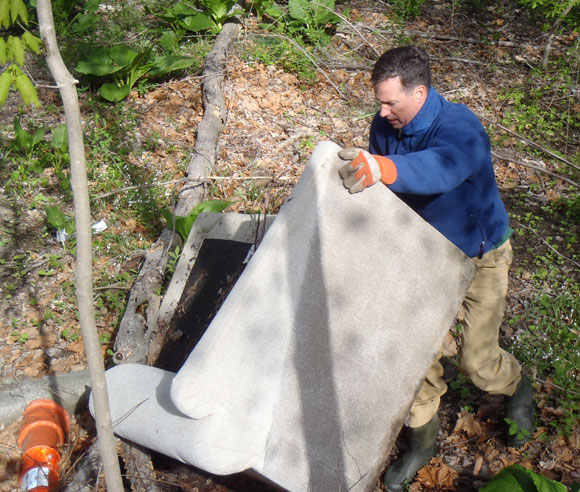
Ross Ogden moves a couch found near the Mill River along Congress Street April 28. Not far from there a TV satellite dish added was found. (John Kovach photo)

Nutmeg takes it to the streams for spring cleanup

Ross Ogden moves a couch found near the Mill River along Congress Street April 28. Not far from there a TV satellite dish added was found. (John Kovach photo)

By Ron Merly

Our multi-stream clean-up was a great success thanks to outside members of the chapter.

Ross Ogden was the point person on the Mill and reported that only Ross, Bill Field and Dave Budds showed up on the Mill River. They worked hard for the three hours and removed a lot of trash.

Gian Morresi reported that he was the only member at the Saugatuck River. Three non-members showed up to help him at Devil’s Den and then they went to the fly-area on Ford Rd. to finish up.
Chuck Macmath was at the Pequonnock. He is on our Board of Directors as well as being a Boy Scout leader. He was able to get thirty scouts and twelve parents at the Pequonnock to remove an entire pick-up truck full of trash from the northern end of Beardsley Park beneath Rte. 8. Local fishermen also put their rods down and helped out with the clean-up. Only 2 chapter members were present.

On the Far Mill River in Shelton, chapter member and point person David Edgeworth reported that 15 people came out and they made a big difference on that stream, removing many bags of trash. Only David and our Treasurer Alan Boyd were members of the chapter out of those 15 volunteers.

It gets more and more difficult for me to donate over 20 hours of my time each week to an organization that has no interest in involvement. Paying your yearly dues goes to the National organization and does not benefit Nutmeg in any way, shape or form. Nutmeg needs volunteers. Was I asking too much for three hours of the memberships time to clean our local streams?

There are members who religiously attend our monthly meetings and benefit from the knowledge of a free speaker as well as eating free pizza (both of which the chapter has to pay for) but those same members never show up for our events. In case you are unaware, this is a VOLUNTEER organization and we don’t ask for much.

When most people join  T.U., they do so with the idea of making improvements on our local streams. How can we do this when only the Board of Directors and a handful of members are the only ones involved ? The BOD constantly has their hands full just trying to keep the chapter running. I am stepping down as President of the chapter this year after three years and out of 370 members, there is no one willing to take this position on. How sad is that?

I would like to gratefully thank all of the members and non-members who came out to make a big difference on our local streams. Clean, healthy water is what T.U. is all about and our local streams are better places thanks to you.

It’s up to anglers to stop ‘rock snot’

From the Connecticut DEEP

Your help is needed to prevent the spread of didymo (Didymosphenia geminata). This highly invasive freshwater form of algae (also called “rock snot”) has now been found in popular trout streams located in a number of northeastern states (New Hampshire, Vermont, New York, Pennsylvania, Maryland, West Virginia and Virginia).

Didymo has the potential to alter food webs and degrade habitat in many Connecticut trout streams.

Didymo is typically found in shallow streams with rocky substrate.

Thought to be native to northern regions of Europe, Asia and North America, didymo originally was found only in cold, clear, low-nutrient waters. Didymo’s geographical and ecological ranges have been expanding, and now also include warmer and more nutrient-rich waters.

The occurrence and intensity of blooms are also increasing. It is currently unclear why.

The microscopic didymo cell produces a stalk to attach to the substrate. During blooms, didymo can produce large amounts of this stalk material, forming thick mats of cottony material that feels like wet wool on the bottoms of rivers and streams. These mats can potentially smother aquatic plants, mollusks, destroy invertebrate and fish habitat, and impact existing food webs.

Anglers are considered an important vector responsible for the recent spread of didymo. The microscopic cells can cling to fishing gear, waders (felt soles can be especially problematic), boots and boats, and remain viable for months under even slightly moist conditions.

What you can do to prevent the spread of didymo:

• CHECK: Before leaving a river, stream or lake, remove all obvious clumps of algae and plant material from fishing gear, waders, clothing and footwear, canoes and kayaks, and anything else that has been in the water and look for hidden clumps. Leave them at the site. If you find any later; treat and dispose of all material in the trash.

• CLEAN: Soak/spray & scrub boats and all other “hard” items for at least one minute in either very hot (140°F) water, a 2% bleach solution, or a 5% dishwashing detergent solution. Absorbent materials such as clothing and felt soles on waders should be soaked for at least 40 minutes in very hot water (140°F), or 30 minutes in hot water (115°F) with 5% dishwashing detergent. Freezing solid will also kill didymo.

• DRY: Drying will also kill didymo, but items must remain completely dry (inside and out) for at least 48 hours.
For more information on didymo:

• US EPA Region 8 website: http://www.epa.gov/region8/water/didymosphenia.

• Biosecurity New Zealand website: http://www.biosecurity.govt.nz/didymo

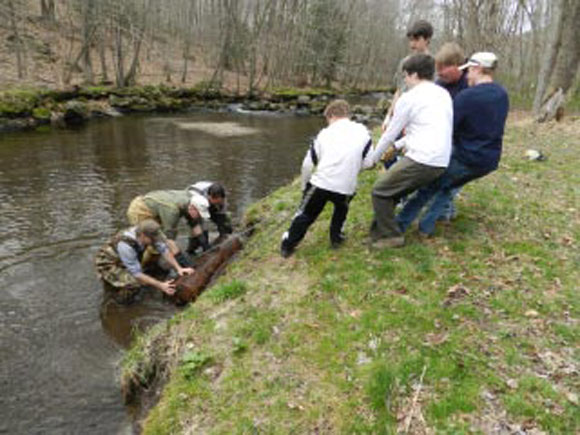
Scouts and volunteers, organized by Eagle Scout Eric Rasmussen, remove refuse from the Halfway River during spring of 2012

Scout gets tons of trash out of Halfway River

Scouts and volunteers, organized by Eagle Scout Eric Rasmussen, remove refuse from the Halfway River during spring of 2012

Eric Rasmussen orchestrated the removal of 6 tons of trash from the banks of the Halfway River just downstream of the Bagburn Hill Road. Bridge on the Newtown side Saturday, March 24, 2012.

The effort was Rasmussen’s Eagle Scout project.

Among the items removed by Rasmussen and his volunteers were two car chassis, a transmission, batteries and two old cast iron water heaters came out of the stream and a huge pile of debris consisting of car doors, hoods, car parts and carpets and whole lot of other junk.

Nutmeg TU President Ron Merly helped roll a cast iron heater out of the stream and cut it in half with a Sawzall.

“This kid went way above and beyond,” Merly said. “He spent over 100 hours attending town meetings in Monroe and Newtown as the river splits the border of those two towns. He then spent every day after school down at the site with his uncle and a battery-powered Sawzall cutting up debris so that it could be dragged up a hill and into a Dumpster. He secured the dumpster from the company for free and got them to donate the money for the scrap to the Boy Scouts.”