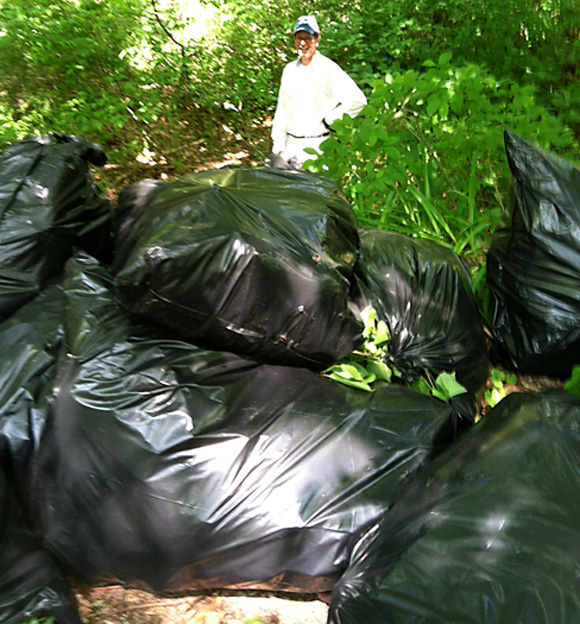
Bob Campbell stacks bags filled with Japanese Knotweed cut and removed from the banks of the Mill River along Congress Street. The nearly 20 bags stacked represent only a few hours work on the project.

Progress on many fronts in Mill River Knotweed removal

Bob Campbell stacks bags filled with Japanese Knotweed cut and removed from the banks of the Mill River along Congress Street. The nearly 20 bags stacked represent only a few hours work on the project.

One of our high-priority goals this year is to take steps to remove invasive Japanese Knotweed where it’s growing along the Mill River so indigenous plants will again line the banks and restore the natural balance of flora and fauna for a healthy stream. We’ve begun with the section flowing along Congress Street in Fairfield because of its concentration of this invasive. Here’s what we’ve done so far:

•    Cut down Knotweed in the biggest growths along the Fairfield side (between the river and Congress St.) from Route 59 downstream (west) to the Congress St. bridge over the river. We have significantly weakened all these growths so their rhizomes and shoots will be more susceptible to controlled herbicide spraying this Fall.

•    Intentionally left selected growths standing as control plots for the upcoming herbicide spraying. This will help us determine the extent cutting is needed going forward vs. spraying only, in our multi-year plan for eradication.

•    Won approval from all(!) eight Easton homeowners on the north bank to help them eradicate knotweed on their properties and cut down the major knotweed growths there. This paves the way for our future collaboration on additional key restoration steps such as improving in-stream structure and sinuosity.

•    Cut down knotweed on the Covenant Church Easton property, having won their support for our efforts.

•   Built/strengthened partnerships with the Fairfield Conservation Department and  Easton Conservation Commission to pursue Knotweed eradication (and other restoration steps) along the Mill.

•    Worked with these departments, the Aspetuck Land Trust and DEEP to determine the best multi-step approach to Knotweed eradication, involving biologically safe herbicide treatment this coming Fall.

•    Begun a plan for free other sections of the Mill from Knotweed incursion, and from other invasive species, building on the work Ross Ogden led for us with the ALT.

So we’ve done a lot with solid results so far, and with more to come! We hope you’ll drive along Congress Street to see how the Knotweed there is weakened and picture how this section of the Mill will look when native plants once again are the only species growing there!

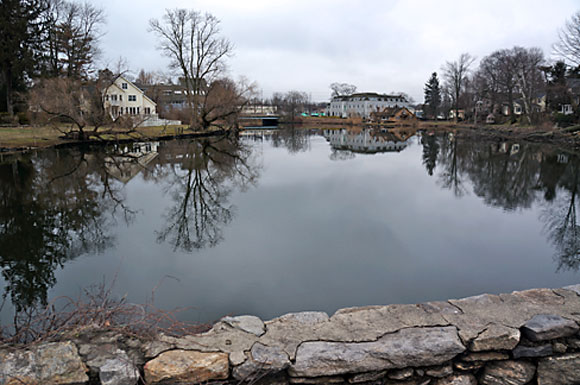
Beneath the surface of the lower Mill River lies lead and other waste from the former Exide battery plant. The company has announced a plan to clean the river, but some neighbors and conservationists fear what the work could stir up. (Fairfield Sun/Shawn O'Sullivan)

Meetings on Exide plan come to Fairfield

Local discussions of a plan to remediate industrial wastes left behind by the former Exide battery plant next to the Mill River are scheduled to begin this week.

The draft plan calls for the lower Mill River to be dredged. The full plan can be downloaded from the Fairfield Conservation Department website, at http://www.fairfieldct.org/conscomiss.htm.

The Harbor Commission will review a draft Remediation Action Plan (SedRAP) Monday, July 8, at 4:30 p.m. in the second floor conference room at Sullivan Independence Hall. Public comment will be allowed.

The Shellfish Commission will perform its review Wednesday, July 10, at 7:30 p.m., also in the second floor conference room at Sullivan Independence Hall.

The Board of Selectmen will also discuss the plan at a date to be announced, and permits will be required for all work.

A hearing with the Department of Energy and Environmental Protection is also pending.

If the Town of Fairfield, the DEEP, Exide and Fair PLAN, a local environmental group, can come to agreement on the plan, the DEEP hearing will be closed and work will begin.

But if those parties cannot agree on how to proceed, the hearing will continue and a hearing officer will determine the course of action based on evidence presented.

Hearings were held in March. Details on the entire process can be found at http://www.ct.gov/deep/cwp/view.asp?a=2719&q=517076&deepNav_GID=1654.

Nutmeg TU members commented during earlier hearings on the proposal.

Fish and fishing would be affected during implementation of the plan.

Part of the deliberations center on increased sediment suspension and a greater disruption to flora and fauna if more material is removed.

“A significant socio-economic issue to consider in assessing overall benefits is the anticipated impact to recreational fishing and shellfish harvesting during and after remedial activities,” the draft reads. “The analysis concludes that risk to humans through consumption of fish/shellfish or ingestion of lead-contaminated sediment is substantially elevated in Area II, and elevated in  Area I, with no substantial risks in Areas III, IV & V.  The present risks  must be weighed against the disturbance of these activities both during  and after remediation.  During remedial activities fishing/shellfish harvesting will not be physically possible in the immediate area of work and the destruction of substrates (i.e. submerged aquatic vegetation (SAV) and the benthic community) on which fish and shellfish are dependent may temporarily decrease fish and shellfish populations.  According to Exponent, recovery of SAV and the benthic community from dredging activities is expected to take 1-3 years.  These factors must be weighed against the overall remedial goal, which is complete removal of human risk from consuming lead-contaminated fish or shellfish.”

The long-term gains from removing lead, according to background in the plan, outweighs short-term disruptions.

Because a installation of a curtain that won’t restrict migration, dredging will not be allowed during the anadromous fish migration period in the Southport Harbor area, bounded by Harbor Road and a project limit line 225 feet south of Harbor Road.

Dredged material will be dried at the former Exide facility, 2190 Post Road, currently a vacant lot next to the Mill River, surrounded by a chain-link fence. That site will also be used for access and egress, staging of equipment and operations headquarters. The east bank of the Mill River, where work stopped during the 2005-09 Upland RAP, will need to be remediated and stabilized to allow the use of this area.

In preparation for the full project, the contractor would need to strip topsoil and install a layer of crushed stone. “The contractor may propose to install asphalt paving in lieu of crushed stone but will need to account for, through the use of engineered controls, any stormwater run-off that may results from this paving,” according to the draft plan.

Dredged material would be placed in Geotubes, “large bags made from a high tensile strength woven polypropylene fabric “geotextile” panels sewn to form long tubes for containment of pumped slurry,” according to the draft plan. The sediment will dry in those.

“In addition,” the plan continues, “two soil/sediment stockpile cells will be constructed using concrete barriers (construction block). Each concrete cell will have a capacity of no more than 250 cubic yards, surrounded by high-density sheeting to contain sediment.

The contractor will be required to “dredge, properly handle, transport and dispos of contaminated material (hazardous and non-hazardous), including characterizing the material, manifesting the loads, and obtaining approval from EPA-approved RCRA landfills and RCRA Out-of-State lined landfills,” according to the plan.

Fairfield’s sewer system cannot handle the volume of water discharged as the slurry is “dewatered,” according to the SedRAP, so filtrate will need to be discharged back into the Mill River.

Exide has applied to the DEEP to permit the discharge under a federal EPA program.

Bacteria sampling, if deemed necessary by DEEP and the Connecticut Department of Agriculture, will be conducted and evaluated by the agencies.

Exide has proposed construction of a “turbidity curtain,” or barrier, to contain sediment, with a corridor 15 feet wide and 2 feet deep to allow migration of fish from April through July.
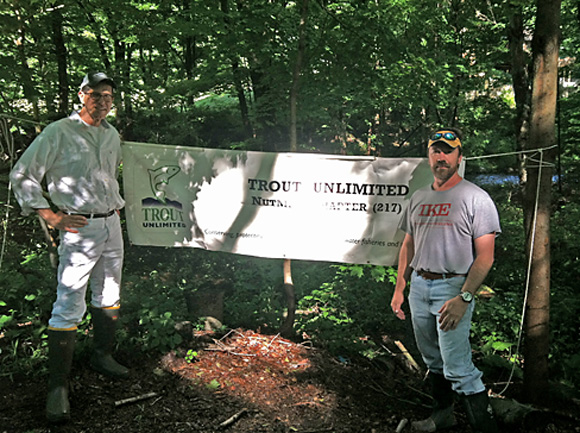
Bob Campbell and Mike Rowinsky with the sign that lets passers-by know who's cleaning up the side of the Mill River along Congress Street.

Help remove knotweed, have a hot dog with friends Saturday

Bob Campbell and Mike Rowinsky with the sign that lets passers-by know who's cleaning up the side of the Mill River along Congress Street.

To help gather manpower for another major push against the knotweed choking the side of the Mill River, Nutmeg TU will hold a cutting day on Saturday, June 29, from 10 a.m. to 2 p.m. along Congress Street.

If you can attend and pitch in for any part of that span, stop by and relieve stress by chopping down an invasive that threatens native species and the flow of the river itself.

We’ll have some food and beverages so members can catch up with each other, telling fish tales and exchanging ideas about this and other projects or group outings Nutmeg can take part in.

If you have not done so yet, drive down Congress Street and see how much progress on removing knotweed small groups have made. Then come out and join the party on June 29.

If you can spare just an hour, it will make a difference. Please RSVP by posting a comment on the events calendar on the website so we know how many hot dogs to buy.

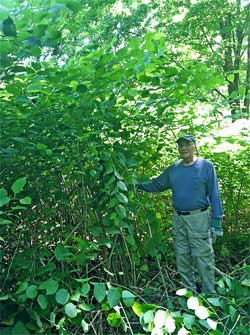
Phil Jacques shows just how tall and dense knotweed can grow if left unchecked. (John Kovach Photo)

Sign up to help restore habitat

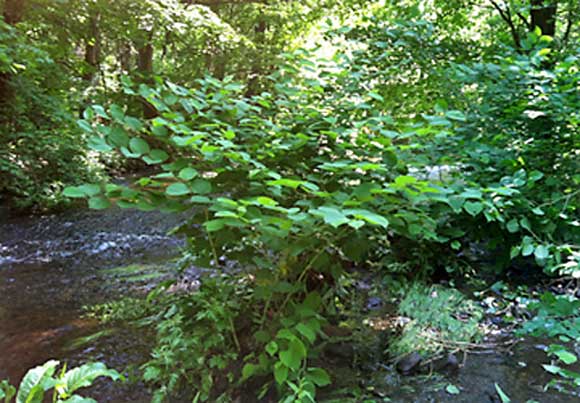
Knotweed growing in the water in the Mill River along Congress Street. (John Kovach Photo)

Volunteers from Nutmeg TU, and their supporters, will return to the banks of the Mill River along Congress Street in Fairfield Saturday and Sunday, June 15 and 16, to continue to hack away at Japanese knotweed that is overwhelming that natural habitat for native plants and beginning to threaten the river itself (see above).

Phil Jacques shows just how tall and dense knotweed can grow if left unchecked. (John Kovach Photo)Working in pairs, a handful of members and a conservationist have cut down the weed, which can approach 10 feet in height, the first two weekends in June. Other than a large bank on a steep slope that will require more help, the tandems have cut down much of the knotweed from the bridge where the Mill River winds under Congress Street to the eastern edge of the Mobil station on the southbound Merritt Parkway.

Thanks to Mike Abramowitz, Phil Jacques and Gian-Andrea Morresi of Nutmeg TU, and Mike Rowinsky, who organized the recent Rooster River cleanup, for pitching in.

Volunteers are needed for morning and afternoon sessions this weekend.

To sign up, go to “Events” under “Get Involved” at nutmegtrout.org. In the June calendar there are 2 sessions listed for each weekend day in June.

Click on any session you wish to sign up for. The event window will open, and below the listing you will see “Leave a reply.” Enter your name and email address in the fields marked with an asterisk, then type “John Doe can attend for the entire session” or “John Doe is available from 9 to 11 a.m.” in the window marked comment. Include a cell phone number where you can be reached if there is a schedule change.

Click “Post Comment” to complete the process. THAT’S IT!!

Please sign up for any and all sessions when you may be able to help by clicking on that particular morning or afternoon session. The process must be repeated for each session you can attend.

Also indicate the maximum number of sessions you can attend so we do not overbook you.

Thanks for your help with the crucial conservation project

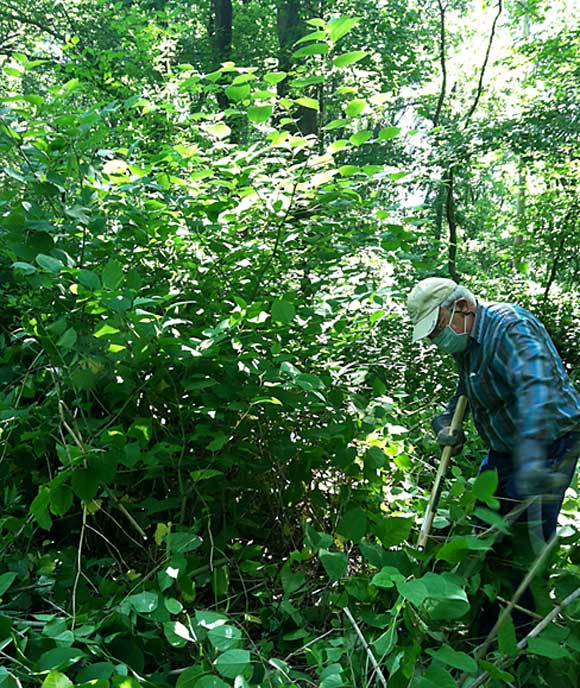
Mike Abramowitz attacks Japanese knotweed some 7 to 8 feet tall Saturday, June 1, 2013. The towering stalks are now only inches tall, but must be cut again to keep the invasive plant from reestablishing itself.

Knotweed removal begins along Mill River

Mike Abramowitz attacks Japanese knotweed some 7 to 8 feet tall Saturday, June 1.

Nutmeg TU members took to the woods over the past week to begin the removal of invasive Japanese Knotweed from land between Congress Street and the Mill River.

Tuesday, President Charles Petruccelli and Vice President Bob Campbell ventured in to make the initial cuts and determine the scope of the project.

Saturday Mike Abramowitz answered the call for volunteers and join John Kovach. The two cut down most of the largest bank of knotweed closest to where the river passes under Congress Street.

Sunday Campbell and Kovach bagged much of the cuttings during a 3-hour period. Some remains to be bagged, but 14 42-gallon bags of knotweed await pickup by the Town of Fairfield.

We need you to help fight invasive species

Nutmeg TU needs more than a few good anglers  to join its war against an invasive species threatening the crown jewel of Nutmeg’s territory, the Mill River.

With the full support of the Fairfield Conservation Office, Nutmeg TU is working Saturdays and Sundays in June to stem the invasion of Japanese knotweed on the banks of the Mill River along Congress Street. Not only is the invasive species pushing out indigenous plants on the ground: The rapidly spreading weed is taking root in the stream itself, on rock piles and gravel bars. (Click here to read more about knotweed.)

Be part of the solution

Nutmeg is about to fire a major salvo in a multi-pronged battle that will take at least a year to win.

During June, volunteers must physically cut all of the knotweed along Congress Street, and drag the remains to the street for pickup. In the fall, when the plant is ready to reproduce, an herbicide safe for use near rivers will be sprayed on the weakened plants. If the stand is successful, then a second cutting next spring should  turn back the invader and allow Nutmeg to begin to plant native species along the Mill River.

A recon team earlier this month determined how to  battle the menace and got a handle on what it will take to get the job done.  This work cannot be done by a handful of people. Nutmeg needs more members to answer the call, up to 20 volunteers on any scheduled cutting.

Sessions are scheduled each Saturday and Sunday in June, from 8:30 a.m. to 12:30 p.m. or from 1 to 4 p.m. An email address is being established so volunteers can register, but drop-ins are welcome especially the weekend of June 1-2.

All volunteers must read this safety advisory.

We’ve been permitted by the town to reclaim the habitat.  It’s up to us to show that we’re up to the task, and people are watching.

Charles Petruccelli, President

Hearing process to begin on Exide cleanup

The Connecticut Department of Energy and Environmental Protection has begun a hearing process on the proposed Mill River cleanup after receiving more than 150 signatures calling for a review.

Only 25 signatures were needed to force a hearing on Exide’s proposal to remove contaminants from the river near the former car battery factory on the Post Road. Click here to read more.

The permitting process for Exide’s plan is now on hold until a remediation plan is finalized.

First Selectman Michael Tetreau and other town officials recently joined state Sen. John McKinney, Rep. Brenda Kupchick, Rep. Tony Hwang and Rep. Kim Fawcett to discuss the cleanup with state officials in Hartford. (Click here to read coverage.)

Updates will be posted as they become available.

Click here for the DEEP page on the project.

Meeting in January on Exide cleanup

A meeting will be held in Fairfield during early January to discuss the cleanup of the Exide Battery property, which will affect the Mill River Improvement Project.

Ron Merly told the Nutmeg TU Board of Directors Tuesday, Dec. 6, that the meeting is tentatively scheduled on or around Jan. 10, 2013. Updates will be posted at nutmegtrout.org.

Merly and Russ Ogden have met with Fairfield conservation officials, and Merly called the plans proposed by Exide “very vague.”

Cleanup plans have been discussed for years, but work has not begun. One current proposal, Merly said, would begin work during the annual Herring migration up the Mill River.

Nutmeg TU will follow the process and encourages members to attend the January meeting. Addresses for local, state and federal officials will also be posted at nutmegtrout.org so members can easily contact elected leaders and express their views on the remediation.

Tom Johnson helped restore native habitat to the Mill River Oct. 6.

New life along the Mill River

Great day down on the Mill River Saturday, Oct. 6. We started at 8:30 a.m., finished up around 12:30 p.m. and had perfect weather for planting.

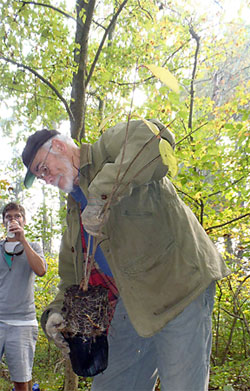
Tom Johnson helped restore native habitat to the Mill River Oct. 6. Roughly 15 folks attended, evenly split between volunteers from TU and ALT. From TU, we had myself, Ron Merly, Bob Campbell, Alan Boyd, Rich Rosen, David Winkelmann, Nick Campofranco and John Kovach. From ALT we had Bob Fatherly, Tom Johnson, Wendy Macbeth, Donna Naser, and Stuart Richardson. (My apologies if I neglected to mention anyone.)

Dave Anderson from New England Wetland Plants was also there. He supplied all of the plants and volunteered his time to help with the planting.

We started the day by splitting into two groups, one for invasive removal and one for planting.  As the day progressed it became all hands on deck for planting. We planted 450 trees, shrubs and plants!

Notable species include (common names): Tulip poplar, sycamore, witch hazel, hornbeam, red-osier dogwood, gray dogwood, silky dogwood, arrowwood viburnum, swamp rose, buttonbush and several species of willow.

Additionally, we were able to preserve several pre-existing American beech, sassafras, black birch and spice bush saplings that would have likely been overcome by all of the invasives.

The area looks great, albeit a little barren, but I fully expect it will start to fill out come spring as many of the species begin to take root and expand their profile. Visitors to the area will note a large amount of deer fencing erected around the perimeter of the main

planting area. This is designed to limit both human and wildlife traffic and hopefully give the plantings an optimal chance for survival.

Going forward we will need to monitor the progress of the plantings and continue to work on the invasive removal. One obvious thing was that the wild grape, multi-flora rose and Japanese barberry continue to remain heavily rooted in the area and several plants had bounced back from our May removal efforts. We will probably need to get a small group out there again in the spring to keep it clean.

Feedback on the project and the results are appreciated. I hope this is the first of many steps in our Mill River Improvement Project.

Many thanks to all those who participated and I look forward to working with everyone again on the next event.

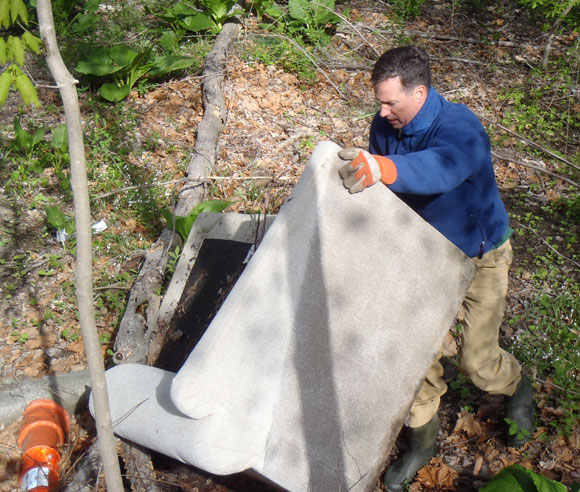
Ross Ogden moves a couch found near the Mill River along Congress Street April 28. Not far from there a TV satellite dish added was found. (John Kovach photo)

Nutmeg takes it to the streams for spring cleanup

Ross Ogden moves a couch found near the Mill River along Congress Street April 28. Not far from there a TV satellite dish added was found. (John Kovach photo)

By Ron Merly

Our multi-stream clean-up was a great success thanks to outside members of the chapter.

Ross Ogden was the point person on the Mill and reported that only Ross, Bill Field and Dave Budds showed up on the Mill River. They worked hard for the three hours and removed a lot of trash.

Gian Morresi reported that he was the only member at the Saugatuck River. Three non-members showed up to help him at Devil’s Den and then they went to the fly-area on Ford Rd. to finish up.
Chuck Macmath was at the Pequonnock. He is on our Board of Directors as well as being a Boy Scout leader. He was able to get thirty scouts and twelve parents at the Pequonnock to remove an entire pick-up truck full of trash from the northern end of Beardsley Park beneath Rte. 8. Local fishermen also put their rods down and helped out with the clean-up. Only 2 chapter members were present.

On the Far Mill River in Shelton, chapter member and point person David Edgeworth reported that 15 people came out and they made a big difference on that stream, removing many bags of trash. Only David and our Treasurer Alan Boyd were members of the chapter out of those 15 volunteers.

It gets more and more difficult for me to donate over 20 hours of my time each week to an organization that has no interest in involvement. Paying your yearly dues goes to the National organization and does not benefit Nutmeg in any way, shape or form. Nutmeg needs volunteers. Was I asking too much for three hours of the memberships time to clean our local streams?

There are members who religiously attend our monthly meetings and benefit from the knowledge of a free speaker as well as eating free pizza (both of which the chapter has to pay for) but those same members never show up for our events. In case you are unaware, this is a VOLUNTEER organization and we don’t ask for much.

When most people join  T.U., they do so with the idea of making improvements on our local streams. How can we do this when only the Board of Directors and a handful of members are the only ones involved ? The BOD constantly has their hands full just trying to keep the chapter running. I am stepping down as President of the chapter this year after three years and out of 370 members, there is no one willing to take this position on. How sad is that?

I would like to gratefully thank all of the members and non-members who came out to make a big difference on our local streams. Clean, healthy water is what T.U. is all about and our local streams are better places thanks to you.